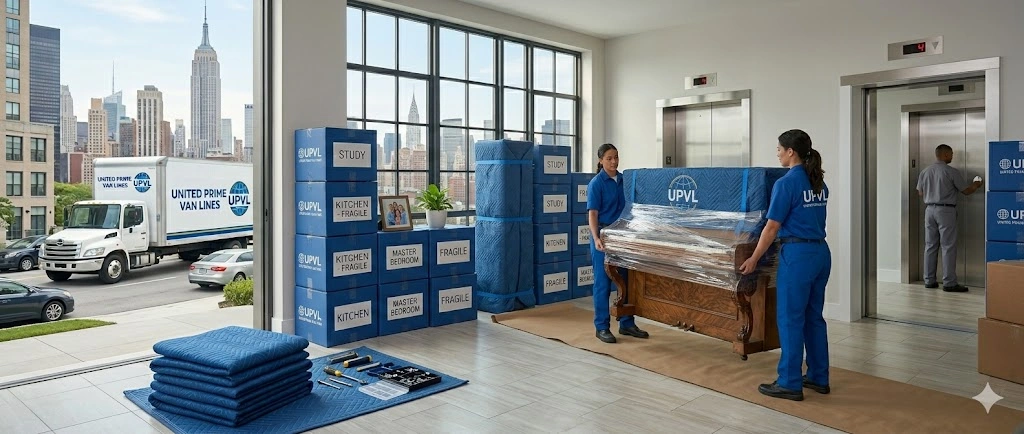
Moving from Miami to another state is a big life shift: new job, new schools, and a completely different climate or lifestyle. When you start preparing for cross country move from Miami, the details can feel overwhelming—routing, packing in humidity, interstate estimates, and picking the right movers who actually show up and deliver on time.
Quick Navigation
Leaving Miami for another state isn’t like a typical local move across town. You’re dealing with interstate regulations, long highways, possible weather delays, and the realities of a multi-day delivery window instead of “same-day” service.
When you compare options for out of state movers Miami residents trust, it helps to understand what makes Miami-based long-distance moves unique.
Miami’s tropical climate shapes almost every part of your move:
Good state to state movers Miami customers rely on will schedule with weather flexibility and use shrink-wrap, mattress bags, and waterproof mattress covers to protect your belongings as they leave Florida’s moisture-heavy environment.
From Brickell high-rises to Kendall single-family homes, access conditions influence cost and timing. Miami has:
These details matter because long-distance movers must plan the truck size, where they can legally park, and whether they need a smaller shuttle truck to reach your building.
| Miami Area | Common Moving Challenges | What Movers May Need |
|---|---|---|
| Brickell / Downtown | High-rises, freight elevator reservations, tight loading zones | COI, specific move times, possible long carries |
| Miami Beach | Narrow streets, limited parking, older buildings | Parking permits, smaller truck or shuttle service |
| Doral / Kendall | Gated communities, HOA rules | Advance approval, truck size confirmation |
| Sunny Isles / Aventura | Luxury condos, strict building security | COI, elevator lock-off, loading dock scheduling |
Discuss your exact address and access with any interstate mover you consider. Accurate access details help avoid surprise fees the day of your move.
When preparing for cross country move from Miami, you’ll quickly see that not all long-distance services are the same. The route you’re taking and the service level you choose affect cost, delivery timing, and the kind of truck used.
Many Miami long-distance moves follow a few familiar corridors:
The longer the route and the more remote your destination, the bigger the delivery spread (delivery window) can be. We’ll unpack delivery windows later, because they’re central to managing expectations on long-distance moves.
Out of state movers Miami customers hire typically offer several service styles. They differ in how your shipment is transported and how quickly it arrives.
| Service Type | How It Works | Best For |
|---|---|---|
| Consolidated / Shared Truck | Your belongings share a trailer with other customers going in a similar direction. | Budget-conscious moves, flexible delivery dates. |
| Dedicated Truck | One truck carries only your shipment, with direct routing to your new state. | Time-sensitive moves, larger homes, high-value items. |
| Partial Load / Small Shipment | Smaller shipments (studio, some furniture) combined with other loads. | Students, small apartments, moving some but not all items. |
| Full-Service Packing & Moving | Movers pack, load, transport, and often unpack at destination. | Busy professionals, families, seniors, complex home inventories. |
Dedicated trucks generally cost more but offer tighter delivery windows and more control over routing. Consolidated options are typically more affordable but may have larger delivery spreads because your shipment is combined with others.
If you’re comparing multiple state to state movers Miami based, ask each which service model your estimate assumes. Two quotes that look similar on paper can actually be totally different in service level.
For many long-distance carriers, your move happens in stages:
Understanding this process helps you appreciate why delivery spreads exist and why a precise hour-of-day delivery time isn’t usually guaranteed on interstate moves.
If you want a more direct, premium experience, some carriers—like United Prime Van Lines long-distance moving services—can often arrange dedicated trucks or tighter delivery windows for qualifying moves.
Planning early is the single best way to reduce stress and avoid higher rates. Miami has peak moving seasons (summer, end of month, weekends) where trucks and crews book up quickly.
For most out-of-state moves from Miami:
If your move is last minute, look for companies that advertise urgent schedules, like last-minute moving support, and be flexible with dates if possible.
| Timeframe | Main Tasks | Key Tips |
|---|---|---|
| 8–10 weeks before | Research movers, request estimates, start decluttering | Verify DOT/MC numbers and read reviews. |
| 6–8 weeks before | Book your mover, reserve condo elevator, sort documents | Confirm COI requirements with building. |
| 4–6 weeks before | Start non-essential packing, decide on storage needs | Label boxes by room and destination. |
| 2–3 weeks before | Finalize inventory, confirm dates with mover, arrange utilities | Share updated item list with mover for accurate estimate. |
| Last week | Pack essentials, empty and defrost fridge, prepare payment | Do a final walk-through for forgotten items. |
Make sure your timeline also reflects Miami-specific tasks: hurricane season checks, elevator reservations in Brickell or Sunny Isles, and allowing extra time for potential afternoon thunderstorms that could slow loading.
Because long-distance shipments move over several days, you usually won’t receive your items the same day you arrive. We’ll detail delivery spreads later, but you should:
Ask your mover for a realistic transit time range and “not sooner than / not later than” dates so you can schedule your travel and utility activations accordingly.
Packing for an interstate move is different from packing for a local relocation. Your items will be loaded, driven for hundreds or thousands of miles, possibly transferred, and then unloaded—so vibration, stack pressure, and climate changes matter.
You can save money by doing your own packing, but professional packing usually provides better protection and saves time. Companies like United Prime Van Lines full packing services offer partial and full options so you can mix and match.
| Packing Option | What’s Included | Who It’s Best For |
|---|---|---|
| Self-Packing | You pack all boxes; movers handle furniture only. | Budget-conscious customers with time and packing experience. |
| Partial Packing | Movers pack fragile or complex items only. | Most families who want pros for kitchen, glass, art. |
| Full Packing | Movers pack all items, supply materials. | Busy professionals, large homes, time-sensitive moves. |
| Unpacking Services | Movers unpack selected rooms or all boxes. | Those wanting quick setup at destination. |
If you’re packing yourself, ask your mover which items must be professionally packed for valuation coverage to apply. Some carriers require pro packing for fragile items if you want them covered under Full Value Protection.
Miami’s heat and humidity require extra thought:
Never ship perishable food, aerosols, flammables, or gas-powered equipment with full tanks. Ask your mover for a “non-allowables” list well before packing day.
A detailed inventory is a core part of any interstate estimate and move. It protects both you and your mover.
A strong inventory also feeds directly into more accurate estimates, whether binding or non-binding. We’ll cover how inventories tie into estimates later in detail.

When moving from Miami to another state, you may not be able to move directly into your new home. Maybe your new lease starts later, or a renovation is running behind schedule. That’s when storage becomes part of your moving plan.
Many long-distance carriers offer storage as part of the overall move. This is often called Storage-In-Transit (SIT). You can also choose an independent self-storage unit, but integrated storage often simplifies logistics.
| Storage Type | How It Works | Pros |
|---|---|---|
| Storage-In-Transit (SIT) | Movers warehouse your items for a limited time during the move. | Simpler logistics, single chain of custody, one company. |
| Long-Term Warehouse Storage | Extended storage at the mover’s facility. | Good for long delays, relocations, or overseas moves. |
| Self-Storage Unit | You rent a unit and movers deliver there or you DIY move. | Direct access to items; flexible for partial retrieval. |
| Portable Containers | Container delivered to your home, then stored or shipped. | Flexible loading; can be stored or moved later. |
Ask your mover if they offer integrated storage, such as options similar to United Prime Van Lines storage solutions, so your shipment can stay within a single system from Miami pickup through final delivery in your new state.
For Miami-origin storage:
If you use your own self-storage unit, check your homeowner’s or renter’s policy to see whether stored items are covered or if you need separate coverage.
Long-distance moving prices can vary widely because there are multiple factors at play, not just the distance between Miami and your new home.
| Cost Factor | How It Affects Price | What You Can Do |
|---|---|---|
| Weight / Volume | More items = higher transport cost. | Declutter, sell or donate before moving. |
| Distance | Longer routes = more fuel, tolls, driver time. | Consider flexible dates to get better routing. |
| Access / Logistics | Stairs, long carries, shuttles add labor. | Reserve nearest parking, elevators, and loading docks. |
| Packing & Materials | Pro packing adds labor and materials cost. | Mix self-pack with pro packing for fragile items. |
| Season & Demand | Summer and end-of-month dates cost more. | Move mid-month or during off-peak if possible. |
Reputable out of state movers Miami residents hire should provide a written estimate that clearly shows what services and assumptions are included. Beware of quotes that seem dramatically lower than others; they may be missing critical services or be based on inaccurate inventory.
Local Miami moves often use hourly pricing. Interstate moves are typically priced by weight (or sometimes volume) plus distance, not by the hour. That means:
Make sure your moving company explains clearly which charges are included and which could be added if conditions change.
Understanding interstate estimates is key to avoiding unpleasant surprises. The Federal Motor Carrier Safety Administration (FMCSA) sets rules for how interstate estimates must be presented and honored.
Interstate movers typically offer two main types of estimates:
| Estimate Type | Definition | Pros / Cons |
|---|---|---|
| Binding Estimate | A written price that guarantees the total cost based on the services and inventory listed. | Predictable cost, but limited flexibility if you add items or services. |
| Non-Binding Estimate | An approximation of cost; final charges are based on actual weight and services. | More flexible, but total may be higher than initial quote. |
| Binding Not-To-Exceed | Your price can go down if weight is lower, but not above a capped amount. | Protection from overages with the possibility of savings. |
| Hourly (Usually Local Only) | Price based on labor hours, truck fee, and materials. | Rare for interstate; mostly for local segments. |
Binding estimate: If nothing changes from the written inventory and services, your price should not increase—provided you don’t add items or services. If you do, the mover must issue a written “revised written estimate.”
Non-binding estimate: FMCSA rules allow carriers to collect up to 110% of the non-binding estimate at delivery, with any remaining balance billed later. Source: FMCSA.
Your inventory is the foundation of any interstate estimate. A vague list like “some boxes, some furniture” is not enough for a reliable quote.
A thorough interstate inventory should include:
Most modern state to state movers Miami homeowners work with use virtual video surveys, phone-based inventory forms, or in-home surveys for larger homes. The more accurate your inventory, the more reliable your price—especially for binding and binding not-to-exceed estimates.
Watch for these warning signs:
Use FMCSA’s Protect Your Move database to check interstate movers’ registration status and complaint history.
When you’re hiring out of state movers Miami based, you want legitimate, licensed carriers—not a brokerage or unlicensed crew that just rents a truck.
Any company that transports your belongings across state lines must be registered with the FMCSA and have a USDOT number and MC number. You can verify a mover’s status by searching their name or number in the FMCSA system.
Key terms:
There are good brokers and bad brokers, but you need to know who is ultimately responsible for your shipment, and that the carrier is properly licensed and insured.
Interstate movers must offer valuation coverage options. Valuation is not the same as third-party insurance, but it defines how the mover is responsible for loss or damage.
| Valuation Type | Coverage Level | Typical Use |
|---|---|---|
| Released Value | Up to $0.60 per pound per item; included at no extra charge. | Budget moves, low-value items, or when you have separate insurance. |
| Full Value Protection (FVP) | Repair, replace, or pay current market value up to a declared amount. | Most families, higher-value shipments. |
| Third-Party Insurance | Separate insurance policy from an insurer, not the mover. | Very high-value shipments or special situations. |
| Additional Riders | Specific coverage terms for certain items or situations. | Fine art, collectibles, antiques. |
Ask your mover to explain in plain language what is covered and what isn’t, and get the valuation terms written into your Bill of Lading. If you’re considering third-party insurance, verify that the insurer understands interstate household goods moves.
Many Miami condos and high-rises require a Certificate of Insurance (COI) from your mover before they allow crews on site. A COI proves that the mover has liability coverage and meets the building’s requirements.
Steps to stay compliant:
Legitimate carriers like United Prime Van Lines in Miami handle COIs regularly and can coordinate directly with your condo association or building manager.
Delivery windows, also called delivery spreads, are one of the most misunderstood parts of an interstate move. Unlike a local move within Miami, your shipment is on the road for days or weeks, sharing the highway with weather, traffic, and sometimes other customers’ shipments.
A delivery spread is the range of dates when your mover expects to deliver your belongings. It might look like “Delivery between June 10 and June 17.”
The spread depends on:
Usually, the mover will contact you 24–48 hours before delivery with a more specific day and approximate time window.
| Route From Miami | Approximate Transit Time | Typical Delivery Spread |
|---|---|---|
| Miami to Atlanta / Charlotte | 2–4 days in transit | 3–7 days from pickup |
| Miami to New York / New Jersey / Boston | 3–6 days in transit | 5–10 days from pickup |
| Miami to Chicago / Detroit | 4–7 days in transit | 7–14 days from pickup |
| Miami to Los Angeles / Phoenix / Dallas | 5–10 days in transit | 7–21 days from pickup |
These are general ranges; your actual spread may differ based on the carrier’s schedule, whether you book a dedicated truck, and the time of year.
To make the delivery window less stressful:
Ask your mover to explain how they track trucks and how often they will update you during transit.

A practical checklist tailored to Miami and interstate rules can keep your relocation on track.
| Stage | Task | Miami / Interstate Tip |
|---|---|---|
| Research | Verify mover’s DOT and MC numbers. | Use FMCSA’s Protect Your Move website. |
| Building Rules | Ask building for COI and elevator rules. | Critical for Brickell, Miami Beach, Sunny Isles condos. |
| Inventory | Make a room-by-room list of items. | Share updates with mover for accurate estimate. |
| Packing | Decide self-pack vs pro pack. | Consider pro packing for humidity-sensitive items. |
| Travel | Book flights, hotels, or driving route. | Arrive before earliest delivery date. |
For larger or more complex interstate moves—especially whole-house relocations—consider a company with dedicated services like United Prime Van Lines house moving support, so planning, packing, and long-distance logistics are handled under one roof.
An interstate estimate for a Miami-to-another-state move is a written document that describes your services, the inventory, and the expected cost. For interstate moves, most reputable movers offer:
The estimate must be provided in writing, and per FMCSA regulations, it should clearly state whether it is binding or non-binding. Accurate inventory and clear access details (stairs, elevators, long carries) are critical for a realistic quote.
The best inventory for an out-of-state move is room-by-room and detailed. Include:
Many movers offer virtual video surveys where you walk them through your Miami home on a smartphone. Update your mover if you significantly add or remove items after the original survey to avoid estimate changes on move day.
A delivery spread is the range of dates when your mover may deliver your shipment at your new home. For example, “Delivery between May 10–17.” It accounts for driving time, weather, route planning, and other customers’ deliveries if you’re on a shared load.
For Miami-to-nearby-state moves, the spread might be a few days. For cross-country trips—like Miami to California—it can stretch to two or three weeks, especially in peak season. The mover usually narrows the date as the truck gets closer and calls 24–48 hours before your delivery.
Plan as if you will not have your furniture and main household items for at least several days after you arrive. To prepare:
Talk with your mover about realistic transit times from Miami to your destination state, considering time of year and route.
A moving carrier owns trucks, employs or contracts the crews, and directly transports your belongings. A moving broker sells your move and then arranges another company (the carrier) to perform it.
Both are legal when properly licensed, but with brokers you should always ask: “Who is the actual carrier that will handle my shipment?” Then verify that carrier’s DOT/MC numbers on the FMCSA website. Make sure the company on your paperwork matches the one that will physically show up in Miami.
If you’re comfortable packing and want to save money, self-packing can work, especially for non-fragile items like clothes, linens, and books. However, for long-distance moves, professional packing is strongly recommended for:
Many families use a hybrid approach: they pack clothing and simple items, and let professionals handle all fragile and high-value pieces. This often makes it easier to claim valuation coverage for delicate items if something happens in transit.
During hurricane season (June 1–November 30), severe weather or hurricane warnings can delay moves in and out of Miami. High winds, heavy rain, and evacuation orders may make it unsafe or impossible to load, drive, or deliver.
Monitor updates from the National Hurricane Center as your move date approaches. Stay in close contact with your mover. Reputable carriers will adjust schedules to keep crews, customers, and shipments safe.
Most high-rise condos and many apartment complexes in Miami require a Certificate of Insurance (COI) before they will allow movers to operate on the property. The COI shows that your mover carries liability insurance and meets any coverage minimums set by the building.
Ask your building manager for their moving packet and COI requirements. Share the sample COI with your mover at least a week before your move so they can issue a compliant certificate and avoid last-minute delays.
To reduce your risk:
FMCSA’s Protect Your Move offers consumer resources and checklists for spotting red flags.
For Florida moves, the contact information is:
Moving from Miami to another state involves more than packing boxes and hiring a truck. You’re navigating interstate regulations, long-distance transit, delivery spreads, Miami-specific building rules, and weather that can shift overnight.
The more detail you share with your mover about your inventory, access conditions, and timing, the more accurate your interstate estimate and the smoother your experience will be. Build in a realistic budget, prepare for a delivery window, and protect your belongings with smart packing and appropriate valuation coverage.
If you’re ready to compare options for state to state movers Miami families rely on, start by gathering two or three detailed, written estimates from licensed carriers. Ask questions until you understand every line of the quote. With the right planning and the right partner, your move out of Miami can be organized, predictable, and a solid first step into your new life in another state.