If you’re planning a move in Miami, here’s the uncomfortable truth: there are a lot of great movers here… and a lot of people with a rented truck and a Facebook page calling themselves “professional movers.”
I’ve seen families overcharged, belongings held “hostage” for extra fees, and people ghosted the night before their move. Almost every horror story started the same way: nobody checked the mover’s license properly.
Let me walk you through, step-by-step, how I personally verify licensed movers in Miami—the same way I encourage our own clients to verify us at United Prime Van Lines. If a mover can’t pass these checks, you don’t want them anywhere near your stuff.
Why Licensing Matters So Much in Miami
Miami is a busy, fast-moving city. People are always coming and going—to Brickell, Wynwood, North Miami Beach, Hollywood, FL, up to Orlando, across the country. That constant churn attracts both solid, established moving companies and a bunch of fly‑by‑night operations.
Being licensed isn’t just a piece of paper. It means:
- The mover is registered with the proper authorities.
- There’s a real, traceable business behind the truck.
- Someone is legally responsible if things go wrong.
- Pricing and liability rules are clear and regulated.
If you only remember one thing from this article, let it be this: Never book a mover in Miami until you’ve checked their license and complaint history yourself.
Step 1: Understand Which Licenses Miami Movers Should Have
Before you start checking anything, you need to know what you’re looking for. In Miami, the type of license depends on where you’re moving.
For Local Moves (Within Miami / South Florida)
If you’re moving from one place in Miami-Dade to another (say, Downtown Miami to North Miami Beach), your mover should have:
- A Florida business registration (active).
- Local operating authority if required (depending on county rules).
- Proper commercial insurance.
- Note: In Florida, local household movers are regulated by the Florida Department of Agriculture and Consumer Services (FDACS).
For Long-Distance Moves (State-to-State)
If you’re moving from Miami to Atlanta or New York, your mover needs:
- A valid USDOT number.
- A valid MC (Motor Carrier) number.
- Active interstate operating authority.
Red flag alert: If a company offers interstate moving services and doesn’t have a USDOT and MC number, you’re not dealing with a legal interstate carrier. At United Prime Van Lines, we encourage anyone considering us for long-distance moving to verify our federal authority.
Step 2: Start With the Mover’s Full Legal Name
Most of the problems start right here. Shady movers hide behind nicknames like “Miami Budget Movers” or social handles with no real company name.
What you need:
- The full legal company name.
- Their “doing business as” (DBA) name, if they use one.
- Their address and phone number.
Ask directly: "Can you give me your full legal company name as it appears on your license, and your USDOT and MC numbers?" A real moving company won’t hesitate.
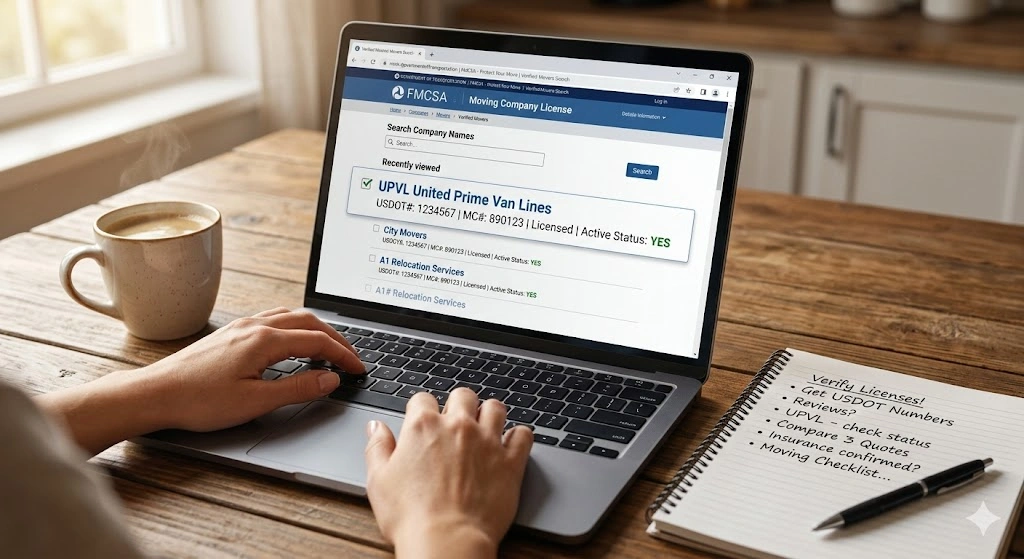
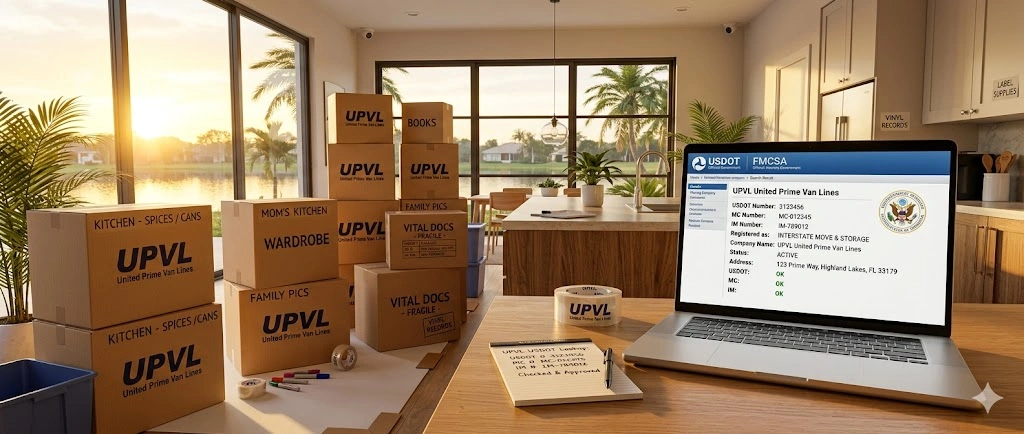
Step 3: Verify Their USDOT and MC Numbers on the FMCSA Website
For any interstate move from Miami, this step is non-negotiable.
- Go to the FMCSA SAFER website (search: “FMCSA SAFER Company Snapshot”).
- Enter the mover’s USDOT or MC number.
- Check the following carefully:
- Company Name: Does it match what they told you?
- Operating Status: Look for “Active”. If it says “Inactive” or “Not Authorized,” walk away immediately.
- Authority Type: You should see “Authorized for Hire” and “Household Goods”.
- Insurance: They must have current insurance on file.
Step 4: Check State & Local Registration for Miami Moves
If your move is within Florida, you still need to verify the mover is properly registered at the state level.
- Check Florida business registration: Search the "Florida Division of Corporations" (Sunbiz). Look for an Active status and a real principal address.
- Look for FDACS license information: Ask the mover, "Are you registered with FDACS as a household mover? Can you share your registration details?"
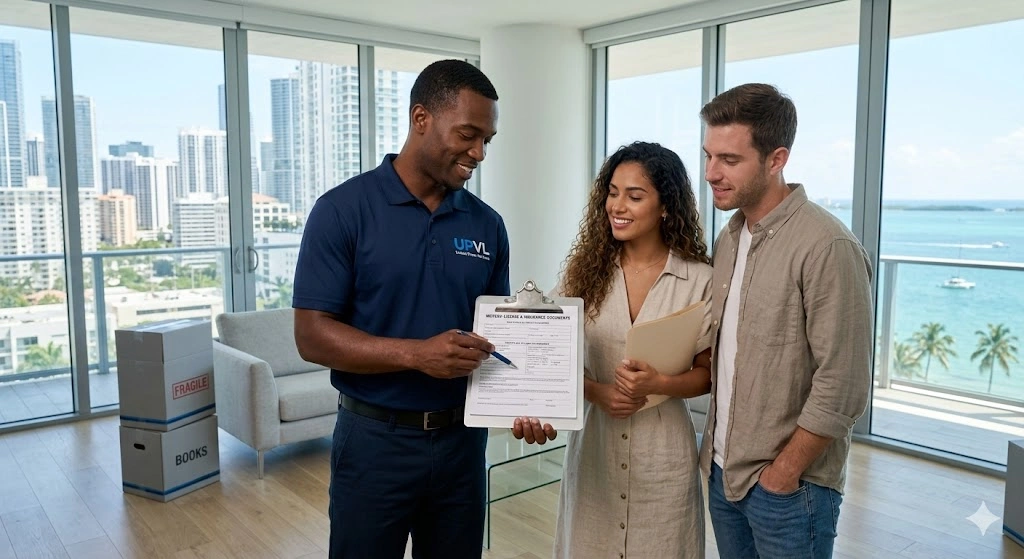
Step 5: Look Beyond the License – Check Complaints
A license tells you the mover is allowed to operate. It doesn’t tell you whether they treat people right.
- FMCSA Complaint History: Check for crash history and safety ratings. Lots of complaints involving hostage loads or billing disputes should give you second thoughts.
- Google, Yelp, and BBB: Read between the lines. Look at recent reviews (last 6-12 months), spot patterns (bait-and-switch pricing), and watch how the company responds to negative feedback. Do they try to fix issues or just argue?
Step 6: Confirm Insurance and Liability Coverage in Writing
A lot of people assume “licensed and insured” means their stuff is fully protected. Not exactly.
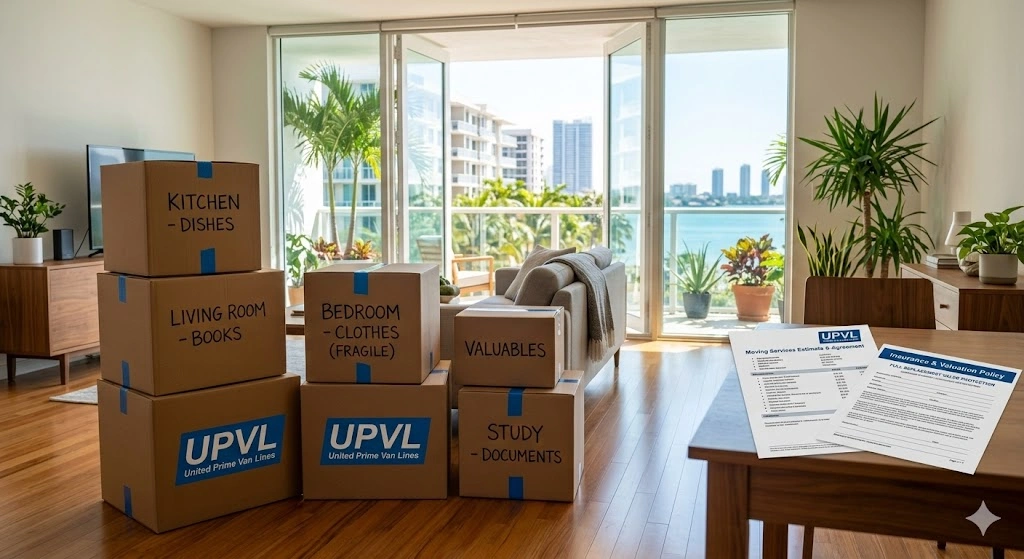
By law, movers must provide basic carrier liability (usually $0.60 per pound per item). If a 50 lb TV is badly damaged, the basic payout might be around $30.
Ask:
- “What type of valuation coverage do you offer?”
- “Is there an option for full value protection?”
- “Can I see a copy or summary of your insurance and valuation policy?”
Step 7: Get a Written, Itemized Estimate
Licensing is one piece. Pricing behavior is another huge clue.
- A Proper Survey: The mover should do an in-home or video walk-through. If they just ask “how many bedrooms?” and fire off a random number, that’s not a serious estimate.
- Clear Type of Estimate: Understand if your quote is Binding, Binding Not-to-Exceed, or Non-binding.
- No Unexplained Deposits: Bad actors ask for big cash deposits upfront (via Zelle/Cash App) and then disappear. Reasonable deposits can exist, but they should be clearly written into your estimate and payable via traceable methods.
At United Prime Van Lines, we always clarify which services are included (packing, storage, stairs, long carries, etc.).
Step 8: Ask These 7 Questions Before You Sign Anything
Use this as your mini “truth detector”:
- “What is your full legal business name and address, and what name is your license under?”
- “Can you give me your USDOT and MC numbers (or state registration info)?”
- “How long have you been operating under this business name?”
- “Do you subcontract my move to another carrier or broker it out?”
- “What’s included in this quote and what would be extra?”
- “What is your claims process if something is damaged or delayed?”
- “Can you email me copies of your standard moving documents to review before I decide?”
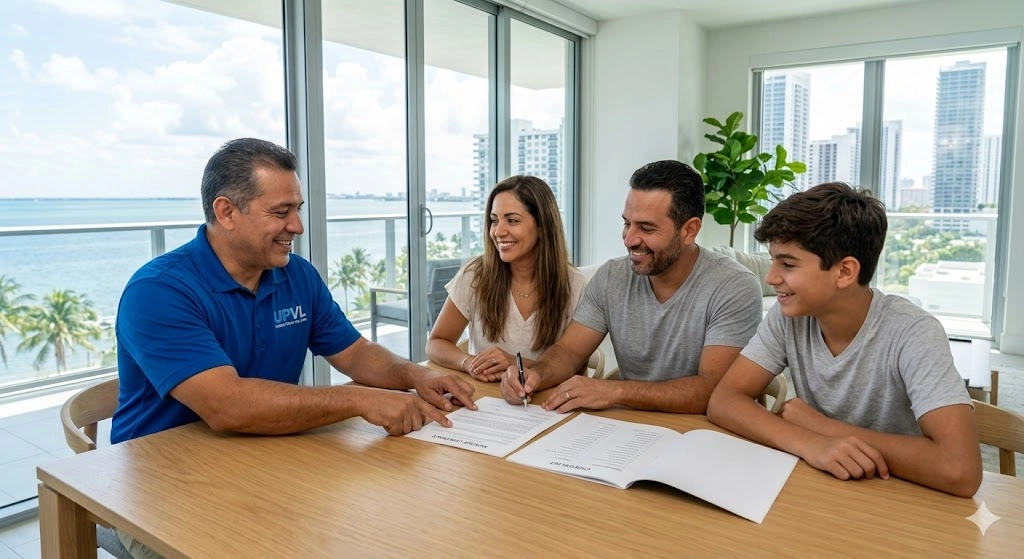
Step 9: Recognize the Biggest Red Flags
Let me spell out a few things that should immediately make you think "Nope."
- No physical address: Only a cell phone and a city name.
- No DOT/MC number: Or they give you one that belongs to someone else.
- Refusing a walk-through: And giving a “ballpark” that sounds too good to be true.
- Demanding a large cash deposit: With no clear documentation.
- Refusing to put things in writing: Saying, “We’ll sort that on moving day.”
- Name confusion: The company name in the contract doesn’t match the website.
How We Encourage Clients to Verify Us
When someone calls us at United Prime Van Lines, I actually want them to go through this checklist. Look us up on FMCSA, check our business registration, and read our reviews. You’re literally putting your life in boxes and handing it to strangers. You deserve to know exactly who those strangers are.
If you want help walking through the verification steps, you can always reach out through our site: https://unitedprimevanlines.com.
Your Simple “Licensed Mover” Checklist for Miami
Screenshot this for when you start calling around:
- Company Identity: Full legal name + DBA, physical address, and phone.
- Licensing: USDOT + MC (verified on FMCSA) and active Florida business registration (FDACS).
- Insurance: Proof of coverage and explanation of liability vs. full value protection.
- Reputation: Recent reviews with no consistent pattern of serious complaints.
- Estimates: In-home/video survey, written itemized estimate, and clear inclusions/exclusions.
- Behavior: No pressure tactics, transparent answers, no large cash deposits.
A Smarter Way to Choose Your Miami Mover
Verifying licenses isn’t glamorous, but spending 30–45 minutes doing your homework now can save you thousands of dollars in surprise fees, weeks of stress, and massive headaches.
When you’re ready to move—whether it’s a local apartment swap in Miami or a big relocation across state lines—my team at United Prime Van Lines is here to help you do it the right way, with everything out in the open from day one.