If you’ve ever moved before, you probably have at least one story that still makes your eye twitch a little. The truth is, behind every “We finally made it!” moving photo, there’s usually a moment where something went wrong, someone panicked, and everyone swore they were never moving again.
We see that side of moving all the time.
As United Prime Van Lines, we get called in a lot when things have already gone sideways—when another mover bailed, when a DIY move fell apart, or when someone’s entire life seems stuck in limbo between Hallandale Beach and who-knows-where. Over the years, we’ve collected plenty of moving horror stories… and more importantly, we’ve helped fix them.
In this article, we’re not here to scare you for fun. We want to walk you through real-world situations (the kinds you or your friends might face) and show how they can be solved with the right approach, planning, and support. If you’re anxious about an upcoming move—whether it’s around South Florida, out of Chatsworth, CA, or across the country—we want you to see that even the worst-case scenarios can be turned around.
You’d be surprised how common this is.
Imagine this: You’re leaving your apartment in Hallandale Beach. Your lease ends today. You booked a cheap moving company you found online, they “confirmed” twice, you took time off work, you packed everything.
Move day: 9 AM arrival window.
At 9:30 AM, nobody’s there.
At 10:15 AM, nobody picks up.
By 11:00 AM, you’re refreshing your email, your voicemail, your spam folder, everything.
Nothing.
Your landlord wants the keys by 5 PM. You’ve got a flight tomorrow. And your entire apartment is stacked with boxes and disassembled furniture.
We’ve gotten calls exactly like this—sometimes from people shaking, crying, or just completely burned out from stress.
In situations like this, the clock is our biggest enemy. Here’s what we typically do when someone calls us in a panic about no-show movers:
1. We stabilize the situation first.
We don’t start with a sales pitch; we start with, “Tell us exactly where you are, what you’ve got, and what your deadline is.” People need to know someone is actually listening and taking responsibility.
2. We check immediate truck and crew availability.
We’ll literally pause the call to talk to dispatch and see which crew we can re-route, how far they are from Hallandale Beach or wherever you are, and what we can realistically do *today*.
3. We create a Plan B and Plan C.
Maybe the best option is a same-day load and overnight storage.
Maybe it’s a partial move now (essentials + big furniture) and a second run the next morning.
The point is: we give you choices, not just “yes” or “no.”
4. We document everything clearly.
When someone’s just been burned by another mover, trust is fragile. So we put everything in writing: pricing, timing, what’s included, what’s not. No “Maybe we can,” no guessing.
In one recent Hallandale Beach case, we were able to get a crew out in about three hours. We loaded the entire one-bedroom apartment that afternoon, did a late-night delivery locally, and the client was completely moved in before midnight. Tired? Yes. Homeless? No.
They told us, “I was sitting on the floor Googling ‘moving emergencies’ and just hoping someone picked up.” That’s exactly the moment we want to be there for.
Sometimes the movers show up… and that ends up being even worse.
We hear this story a lot from people moving out of condos in South Florida and houses in places like Chatsworth, CA:
They hired a mover based only on price. No license check, no reviews, just the lowest number.
On move-in day at the new place, they open the truck and see:
In one case, a family moving from South Florida to the Carolinas showed us a picture of their mattress thrown in the truck with no plastic cover, laying under dusty items and tools. By the time it arrived, it looked like it had survived a hurricane.
They called us not to move them—but to ask what, if anything, could be done next time to avoid this level of damage.
If someone is mid-disaster and asking for help, we break it down into two parts: damage control now, and protection for next time.
For the current mess, we:
For their next move, we walk them through exactly how we handle protection:
1. Professional packing for fragile items.
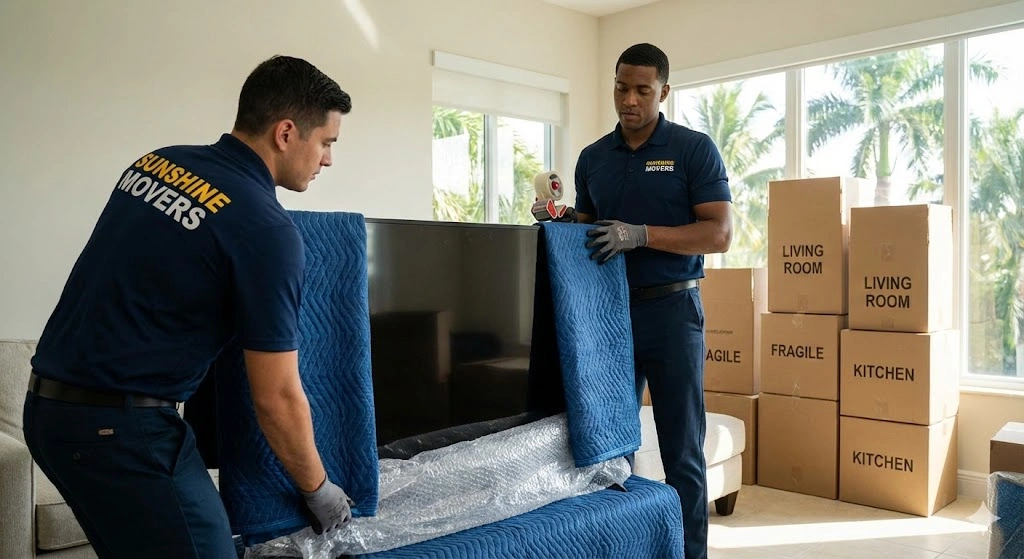
We wrap TVs, glass, art, and mirrors with materials that can take a cross-country ride. That doesn’t mean overwrapping everything “just because,” but using the right amount of padding, corner guards, and labeling.
2. Furniture protection by default.
With us at United Prime Van Lines, padding furniture isn’t some “extra” we try to upsell—it’s just how we work. We blanket-wrap, shrink-wrap where needed, and we don’t stack heavy boxes on top of delicate furniture just to make it fit.
3. Realistic expectations.
If something *is* fragile or already weakened (older furniture, pressboard pieces, cracked glass), we’re honest about the risk and suggest options, like extra crating or you taking smaller valuable items in your own vehicle.
4. Clear coverage options.
We walk through what’s covered and how, in plain language. No one should discover how little coverage they have after something has already broken.
In that South Florida family’s next move, they hired us. We did full packing of their kitchen, wrapped their furniture properly, and used mattress covers and custom TV boxes. The husband told us at delivery, “I opened the truck expecting to wince, and instead it looked like everything had just been loaded an hour ago.”
That’s not magic; that’s process.
This one is a true horror story: the hostage move.
Here’s how it often goes:
We’ve heard it in so many versions:
Suddenly, the price is double—or more.
At that point, your entire life is on their truck. If you refuse, you risk your items being taken to storage or, in the worst scenarios we hear about, not being delivered until you pay inflated fees.
We’ve had clients call us midway through these situations, desperate for a way out, or vowing never to fall for it again.
When someone tells us, “I just went through a bait-and-switch move,” our job is to rebuild trust with specifics, not fancy promises.
Here’s what we do differently at United Prime Van Lines:
1. We insist on a detailed inventory.
That might mean a phone or video walk-through, photos, or a written list we help you build. If we don’t understand what we’re moving, we can’t give you a real price. So we don’t pretend.
2. We explain how pricing actually works.
For local moves (say, within Hallandale Beach or greater South Florida), we usually price by the hour, with clear minimums. For long-distance, it’s usually based on weight or cubic feet, plus distance.
We tell you exactly which one applies to you, and what variables might change it.
3. We show you what might change—and how much.
If you add an entire storage unit of stuff the day before, sure, the price will change. But we outline those “if/then” situations clearly so you’re never surprised.
4. We send written agreements that match what we say.
No verbal “Don’t worry about it, we’ll make it work” that disappears later. You’ll see your scope, your rates, and what’s included or not.
In one case, a couple moving out of Chatsworth, CA had just gone through this hostage situation with a different company on a previous move. This time, they grilled us—in a good way.
We welcomed it. We talked them through line by line: packing, stairs, long carry, elevator, shuttle fees if needed. By the time we showed up on move day, they already knew exactly what to expect. When the final invoice matched what they’d planned for, they almost looked confused.
As the husband said, “I kept waiting for the ‘gotcha’ moment… and it never came.”
That’s how it should be.
Not every horror story involves a bad moving company. Sometimes, it’s pure DIY overload.
We’ve seen this with a lot of people moving from apartments and condos in South Florida and California:
Reality:
By late afternoon, you’re sweaty, behind schedule, and realizing there’s no way you’ll finish today. The truck has to be back in the morning. Your building is strict about move-out times. You can feel the panic creeping in.
We’ve had people call us mid-DIY-disaster, saying things like, “We tried to do it ourselves. We can’t. Is there anything you can do *today*?”
Every situation is different, but here’s how we typically rescue a collapsing DIY move:
1. We prioritize the big pieces.
We focus our crew on the furniture, heavy items, appliances, and anything that physically requires professionals. If you want to keep moving smaller boxes or personal items with your own car, you can.
2. We work with your building’s rules.
Especially in places like Hallandale Beach, buildings have strict elevator windows, COI requirements, and loading dock rules. We coordinate with the front desk or management, and we respect those time frames.
3. We adjust the plan to what’s still realistic.
If it’s already 3 PM, promising a full pack + move + unpack is unrealistic. But loading everything today and delivering early tomorrow might be totally doable.
4. We don’t make you feel dumb for trying.
We get it. Moving is expensive, and a DIY move *can* work in the right situation. Our job isn’t to lecture you; it’s to help you get to the finish line without losing your mind—or your security deposit.
One South Florida client told us they lost half a day just trying to figure out how to get a sectional out of the door without destroying the wall. Our crew had it out, padded, and on the truck in under 15 minutes. That’s not because they were “doing it wrong”; it’s just what we do all day, every day.
By the end of the night, they looked at the empty apartment and said, “We spent three weeks stressing about this, and you guys solved it in one evening.”
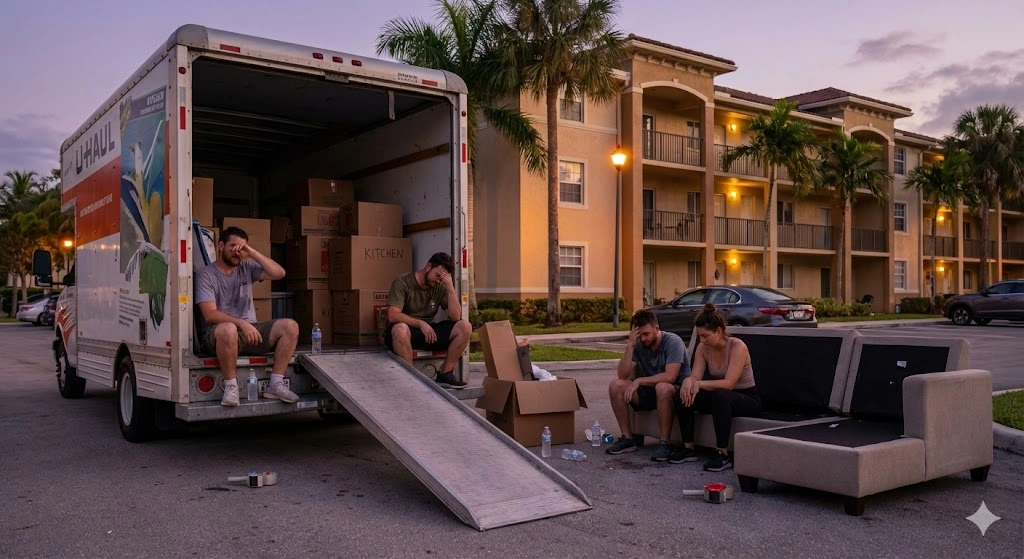
Another type of horror story is quieter but just as stressful: you’ve moved across the country, but your belongings are… somewhere.
You relocate from South Florida to another state. You arrive at your new home with your suitcase and a couple of essentials. The movers? They give you a broad delivery window: “7–14 business days.”
Day 3: You’re okay. Air mattress, few dishes, you can handle it.
Day 8: You’re getting tired of eating takeout on the floor.
Day 13: You’re calling the company, getting vague answers like “Your shipment is in transit.”
Day 17: You’re starting to worry if you’re ever seeing your stuff again.
When people come to us after an experience like that, they don’t just want better logistics. They want better communication.
At United Prime Van Lines, long-distance moves are a big part of what we do, especially from places like Hallandale Beach and greater South Florida to other states. We know that once you’re physically separated from your belongings, your brain fills the gap with worst-case scenarios.
Here’s how we handle it differently:
1. Honest delivery windows.
We don’t promise a three-day delivery from Florida to California if we know that’s not realistic. We’d rather give you a slightly longer window and beat it, than promise something we can’t hit.
2. Real updates, not copy-paste responses.
When you call us or message us, we don’t just say, “It’s in transit.” We tell you where your truck is in the route, what the next step is, and what the current estimated delivery day looks like.
3. Coordinated arrivals.
We work with your schedule and try to avoid those “Anytime between 8 AM and 10 PM” delivery promises. There’s always some flexibility needed—traffic, weather, DOT rules—but we tighten the window as we get closer.
4. Clear expectations before we even load.
On pickup day, we walk you through what happens next:
We had a client moving from South Florida to the Midwest who’d been burned badly on a previous move—zero communication and a truck that showed up nearly a month late. This time, we stayed in touch at each major step. When our driver called them the day before arriving and said, “I’m about 5 hours out; I’ll see you tomorrow between 9 and 11 AM,” you could hear the relief in their voice.
They told us, “Knowing where our stuff was mattered almost more than how fast it got here.”
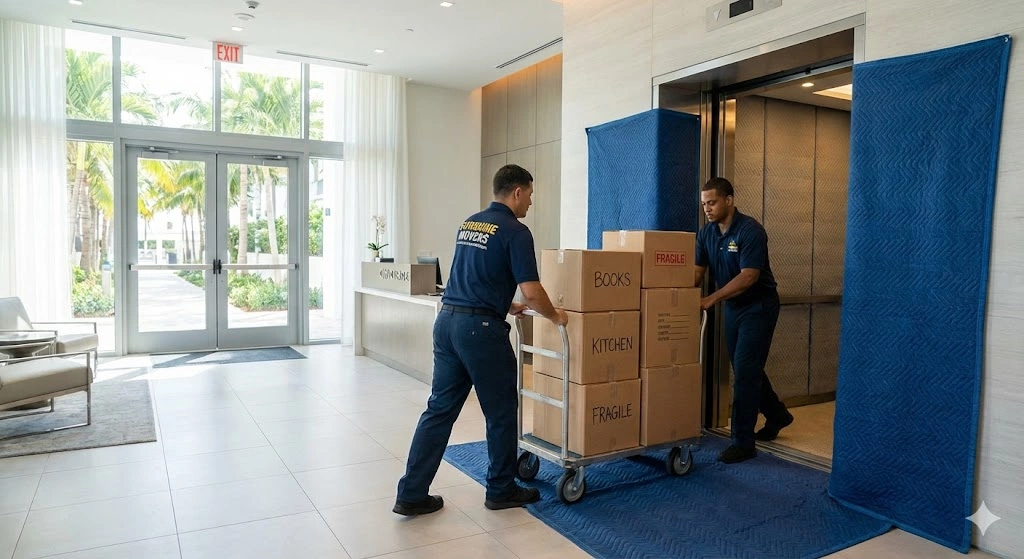
If you live in a condo or high-rise—especially around Hallandale Beach or Miami—you know this horror: building rules you didn’t know existed until move day.
You’ve got your movers lined up. You’re packed and ready. Then, on the morning of the move or the day before, you find out:
If your mover isn’t used to dealing with this—or if you didn’t realize you needed to ask—the whole move can grind to a halt.
We’ve had people call us from their building lobby saying, “Our movers are here, but the front desk won’t let them in because they don’t have the right documents. What do we do now?”
We deal with condos and HOAs all the time, especially in South Florida, so we build that into our process:
1. We ask about your building up front.
If you tell us you’re in a condo or high-rise, we don’t skip over that. We ask about management, elevator reservations, loading area, move-in/move-out hours, and COI requirements.
2. We provide COIs quickly.
If your building needs a Certificate of Insurance, we get it issued and sent to them. We know the language most buildings look for, and we’re used to adjusting it to their template if needed.
3. We respect their schedule, not just ours.
If your building only allows moves between 10 and 4, we book our crew accordingly. It might mean starting early at another job or sending a dedicated team—but we do it.
4. We play nice with management.
You don’t want a mover arguing with your building staff. We’re professional, we follow the rules, and we keep things clean and orderly so you stay on good terms with your HOA or landlord.
One Hallandale Beach client told us their last mover showed up without a COI, argued with the security guard, and was asked to leave. They lost an entire day, plus the elevator slot, and had to beg the building for a second chance.
When they moved again and used us, we coordinated everything with the front desk ahead of time. On move day, the guard actually said, “You guys came prepared,” which is exactly what we want to hear.
Every nightmare move we’ve seen has taught us something. Over time, patterns repeat. When we’re planning your move—whether locally in South Florida, from Chatsworth, CA, or cross-country—we’re quietly watching for the red flags and fixing them before they turn into full-blown problems.
Here are a few things we always recommend (and build into how we work):
1. Don’t choose on price alone.
We know it’s tempting. But if one quote is *way* lower than everyone else’s, you’re probably not getting a better deal—you’re getting less honesty.
2. Ask for clarity on everything.
Stairs. Elevators. Long carries. Assembly and disassembly. Packing. Storage. If something isn’t mentioned, ask about it. A good mover will be happy to explain.
3. Be realistic about DIY.
If you’re young, in good shape, and moving a studio across town with a couple of friends? DIY might actually work. But once you’ve got stairs, heavy furniture, long distance, kids, pets, or a tight timeline, bringing in pros is usually cheaper than a back injury or lost wages from taking extra days off.
4. Plan for building rules early.
Call your property management, ask what they require for moves, and loop us into that conversation. The sooner we know, the smoother things go.
5. Stay in communication.
Tell us if your inventory changes. If your move date shifts. If you’re adding a stop at a storage unit. The more accurate the info, the more accurate—and fair—the plan and price.
If you’re reading this because you’re *in* a moving horror story right now—your movers disappeared, your DIY move crashed, or your timeline fell apart—you’re not alone, and you’re not stuck.
We can:
At United Prime Van Lines, we don’t just move boxes. We move people through one of the most stressful transitions in life. We’ve watched panic turn into relief more times than we can count—and that moment, when you finally lock the door to the old place and know the hard part is over, is what we work for.
If you’re getting ready to move in South Florida, leaving Chatsworth, CA, or relocating anywhere across the U.S., we’d be glad to talk through your plans, spot the potential trouble areas, and build a move that feels like a story you’ll actually want to tell later.