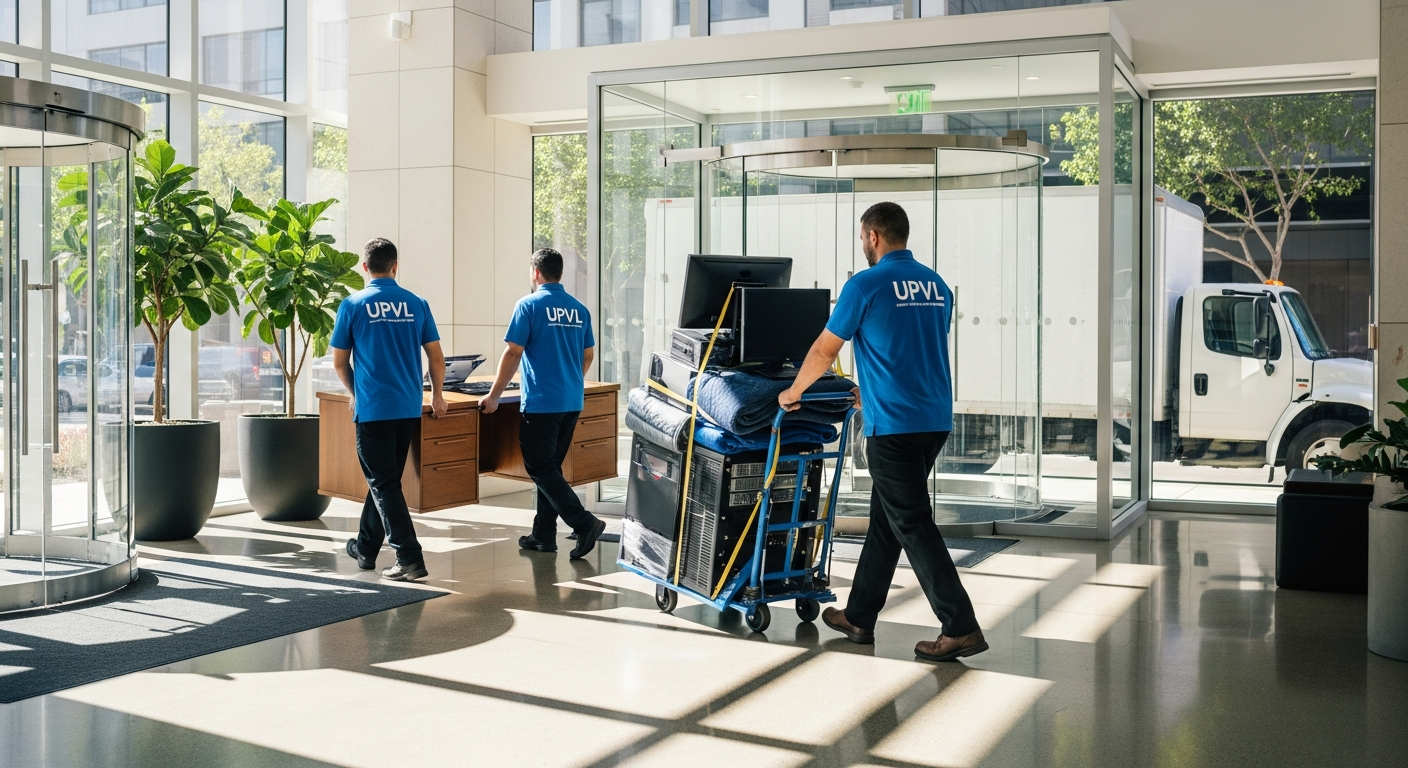
Relocating a business in Los Angeles is a high-stakes project. Tight building rules, traffic, and technology-heavy offices mean you need commercial movers LA companies can trust to keep downtime low and operations protected.
Quick Navigation
Office relocation Los Angeles projects are very different from residential moves. A business move is really a continuity and risk-management project with trucks and tools attached.
For LA businesses, a poorly managed relocation can cause:
By contrast, experienced business movers Los Angeles companies hire will:
Los Angeles adds extra layers to the equation: dense traffic corridors, strict downtown high-rise rules, creative studios in converted warehouses, and large logistics facilities around the Port of LA and Inland Empire routes.
That’s why choosing commercial movers LA owners can rely on is less about “who has a truck” and more about “who understands how LA buildings and businesses work.”
Commercial moving in LA covers far more than standard office suites. United Prime Van Lines routinely works with offices, warehouses, retail stores, and production offices tied to the entertainment industry.
Here are the most common commercial projects and what makes each unique.
| Move Type | Main Challenges | Typical Solutions |
|---|---|---|
| Office moves | IT protection, employee workstations, building rules | Color-coded labeling, weekend moves, COIs, desk & cubicle breakdown |
| Warehouse relocations | Pallet racking, inventory control, forklift zones | Pre-move inventory, staged sections, palletized loads, rack teardown/rebuild |
| Retail store moves | Fixtures, displays, glass, mall/center hours | Crating for glass, fixture disassembly, night or early-morning scheduling |
| Production offices | Media equipment, confidentiality, time-sensitive schedules | Specialized packing, secure transport, tight timelines around productions |
Whether you’re shifting a small creative office in Silver Lake, moving a warehouse operation from Vernon to Commerce, or opening a new retail space at The Grove, the planning and service mix will look different.
Most professional commercial movers in LA, including United Prime Van Lines’ office & commercial moving team, offer a combination of these services:
Each business type has different risks and priorities.
| Business Type | Top Priority | Special Considerations |
|---|---|---|
| Corporate office | Minimize downtime for staff | Workstation mapping, secure file handling, IT cutover coordination |
| Warehouse / distribution | Keep orders flowing | Section-by-section moves, racking, forklifts, dock scheduling |
| Retail store | Fast reopening | Merchandising plan, security systems, mall/center rules |
| Production office | Protect creative assets | Media storage, NDAs, specialized crates, time-sensitive setups |
Clarifying which category your move fits into helps your commercial mover build a project plan that fits how you actually earn revenue.
Los Angeles is one metro, but different areas feel like separate cities when you’re planning a commercial move. Neighborhood access, parking, and building rules can change the cost and timeline significantly.
Here are sample logistics issues commercial movers LA companies face in common business hubs.
| Area | Typical Business Type | Main Moving Challenges |
|---|---|---|
| Downtown LA (DTLA) | Corporate offices, law firms, creative agencies | High-rise elevators, loading docks, strict COIs, rush-hour traffic |
| Hollywood / West Hollywood | Production offices, post houses | Narrow streets, limited parking, sensitive AV gear |
| Santa Monica / West LA | Tech, media, startups | Garage clearance, tight dock times, residential-adjacent buildings |
| Chatsworth / San Fernando Valley | Warehouses, light industrial | Large square footage, racking, long walks inside buildings |
| South Bay / El Segundo | Aerospace, logistics | Security, dock schedules, high-value equipment |
Local traffic is a serious factor. According to LADOT, LA corridors experience heavy congestion during morning and evening peaks, which is why many business movers Los Angeles teams propose early morning, night, or weekend windows to avoid lost time sitting in traffic.
Most Class A and Class B office buildings in LA require:
Professional commercial movers will request your building’s move-in/move-out rules early, then issue a COI and schedule service accordingly.
When you work with a provider like United Prime Van Lines in Los Angeles, building coordination is typically handled by the move coordinator in advance, reducing last-minute surprises.
Production offices in Hollywood, Burbank, and Culver City add extra requirements:
This is where a mover with experience in production-office relocations becomes especially valuable, as they understand the language and workflows of the entertainment industry.
Commercial moves can be local (within Los Angeles County) or long-distance (state-to-state or cross-country). The planning, pricing, and regulations change significantly when you cross state lines.
Examples of local routes include:
Local moves are often billed hourly, with costs driven by crew size, truck count, and total hours required. They still require building COIs, elevator reservations, and possibly overnight or weekend work.
Corporate relocation LA projects can include:
Interstate relocations fall under federal rules governed by the Federal Motor Carrier Safety Administration (FMCSA). That means different estimate types, valuation options, and delivery windows than local moves.
Long-distance commercial projects often involve:
For long-distance needs, many LA businesses work with a carrier like United Prime Van Lines’ long-distance moving service to coordinate freight, office equipment, and individual employee moves under one umbrella plan.
| Route Example | Business Type | Key Planning Points |
|---|---|---|
| Los Angeles to Phoenix | Regional office & small warehouse | Hot weather protection, coordinated rack teardown and rebuild |
| LA to San Francisco Bay Area | Tech or SaaS office | Server move coordination, limited downtown SF access |
| LA to Dallas/Fort Worth | Distribution warehouse | Phased inventory move, dock schedules, multi-truck planning |
| LA to New York City | Media/production office | High-rise loading rules, tight NYC street access, separate IT shipment |
A successful office relocation Los Angeles project starts with a clear, realistic plan. The sooner you set dates and responsibilities, the easier it is to keep the business running while everything moves around it.
An effective office move plan answers these key questions:
For most LA offices, planning should begin 2–6 months before the target move date, depending on size and complexity.
| Time Before Move | Key Tasks | Responsible Parties |
|---|---|---|
| 8–12 weeks | Select commercial movers, confirm new lease, gather building rules | Leadership, facilities, HR |
| 6–8 weeks | Finalize floor plan, assign move champions, schedule IT cutover | Facilities, IT, department heads |
| 4–6 weeks | Distribute packing instructions, label systems, and move schedule | Move coordinator, movers |
| 1–2 weeks | Pack non-essentials, confirm COIs, elevator/dock reservations | Employees, movers, building management |
| Move day/weekend | Execute move, set priority workstations, basic IT up first | Movers, IT, on-site managers |
To keep downtime as low as possible:
Professional business movers Los Angeles companies hire also provide on-site supervisors who can make real-time decisions and keep teams on track.
Commercial relocations revolve around more than just desks and chairs. Computers, servers, specialized machinery, sample libraries, and retail fixtures all need tailored handling.
IT downtime can paralyze a business. To minimize risk, many companies either:
Safely relocating IT typically involves:
Movers like United Prime Van Lines can handle furniture-based tasks (desking, racks, mounts) and coordinate timing with your IT professionals.
Commercial movers LA businesses work with typically offer three main packing approaches.
| Packing Level | Best For | What Movers Do |
|---|---|---|
| Full packing | Busy teams, confidential files, tight timelines | Pack nearly everything, including files and supplies, following your instructions |
| Partial packing | Mid-sized offices with some internal support | Pack IT, fragile items, and key areas; employees pack personal/desk items |
| Self-packing | Smaller offices with limited budgets | Provide boxes/labels; your team packs, movers handle loading and transport |
Many LA businesses choose partial packing, where movers focus on complex or fragile areas (IT rooms, conference rooms, artwork) while staff handles personal items and basic desk contents.
Different business types have specialized items:
These may require:
For artwork and specialty items, a provider with services like art and antique moving can ensure proper packing and transit protection.
Many commercial moves in Los Angeles involve some form of storage, especially during renovations, phased expansions, or lease-overlap gaps.
Common reasons include:
| Storage Type | Best For | Considerations |
|---|---|---|
| Short-term warehouse storage | 1–90 days during a move or build-out | Often billed monthly; easy to integrate with moving schedule |
| Long-term storage | Extra furniture, archived files, props | Look for climate control and inventory tracking |
| Storage-in-transit (SIT) | Interstate moves with flexible delivery dates | Governed by interstate tariffs and valuation rules |
| Containerized storage | Flexible off-site options | May be useful for phased deliveries to multiple locations |
When storage is needed, working with a single company that provides both moving and storage, such as United Prime Van Lines storage solutions, simplifies coordination and accountability.
Business movers Los Angeles companies hire use different pricing models depending on size, distance, and complexity. While every project is unique, there are recurring cost factors you can plan around.
Commercial moving costs are typically driven by:
Local office and warehouse moves in LA are often billed hourly. For larger or more complex jobs, commercial movers may offer a flat rate or a not-to-exceed quote based on a detailed survey.
| Pricing Model | How It Works | Best For |
|---|---|---|
| Hourly rate | Pay for time used based on crew size and trucks | Smaller offices, simple moves with predictable conditions |
| Flat rate | Set price based on detailed inventory and scope | Mid- to large-size offices, warehouses, or complex jobs |
| Not-to-exceed | Price won’t exceed a cap, but can be lower if done faster | Companies wanting cost protection with some flexibility |
| Hybrid | Flat rate for core move, hourly for add-ons | Projects with known scope plus potential extras |
Even with hourly pricing, a good mover will provide a realistic range based on previous similar commercial moves in LA.
Because every project is different, it’s impossible to publish a single price list that fits all. However, approximate brackets can help with planning:
The best way to get accurate numbers is to request a commercial on-site or virtual survey so the mover can see access, inventory, and special items.
Understanding estimate types helps you manage budget risk, especially for corporate relocation LA projects or interstate moves that fall under FMCSA rules.
The FMCSA defines three main estimate types for interstate moves, which also serve as concepts for commercial projects:
| Estimate Type | Budget Predictability | When to Use |
|---|---|---|
| Non-binding | Lowest | Small, straightforward projects with limited risk |
| Binding | High | Well-defined scope, detailed inventory, clear timeline |
| Not-to-exceed | Very high | Complex jobs where you want upside savings but cost protection |
For many commercial clients, a binding or not-to-exceed estimate is worth it for the predictability, especially when finance teams need clear budgets.
If you add significant items or services after the estimate—such as extra storage, additional departments, or extra days—your mover will usually issue a change order. Clarify your internal approvals process so changes don’t stall move-day operations.
Commercial moves involve more regulatory oversight than most people realize. Verifying licensing, insurance, and COIs is essential risk management.
For local moves within California, moving companies must be licensed by the California Bureau of Household Goods and Services (BHGS). For interstate moves, they must also hold a valid USDOT number and, often, an MC number regulated by the FMCSA.
When evaluating commercial movers LA businesses should:
It’s important to distinguish between the mover’s liability (valuation coverage) and your own insurance.
Discuss which assets are most critical (servers, high-value equipment, artwork) and understand how they’re protected under different coverage levels.
Most Los Angeles office towers, medical buildings, and Class A/B spaces require movers to provide a COI before they will confirm elevator or dock reservations.
A COI typically shows:
Professional movers can issue customized COIs within a short time frame, but building management may require specific language, so it’s best to request these needs early.
A structured checklist keeps your team aligned as you move through the project. Customize the following list to your size and industry.
| Task | Timeline | Owner |
|---|---|---|
| Select commercial mover and confirm dates | 8–12 weeks out | Leadership / Facilities |
| Collect building rules and COI requirements from both locations | 8–10 weeks out | Facilities / Office Manager |
| Finalize new floor plan and department layout | 6–8 weeks out | Leadership / IT / HR |
| Decide on packing level (full, partial, self) | 6–8 weeks out | Facilities |
| Schedule IT cutover and phone/internet installations | 4–6 weeks out | IT / Vendors |
| Distribute employee packing and labeling instructions | 3–4 weeks out | Move Coordinator / HR |
| Confirm elevator and dock reservations | 2–3 weeks out | Facilities / Movers |
| Pack non-essential areas (archives, storage rooms) | 1–2 weeks out | Department Leads |
| Move day coordination and on-site supervision | Move day/weekend | Facilities / Movers |
| Post-move punch list and debris removal | 1–5 days after | Facilities / IT |
Using a dedicated move coordinator—either internal or from your moving company—helps keep this checklist moving and ensures no item is overlooked.

Start by defining your target move date and working backwards. List all major tasks: selecting a commercial mover, gathering building rules, finalizing floor plans, and planning IT cutover. Assign an internal move coordinator and department “move champions.” Work with your mover to build a phased schedule, including after-hours or weekend slots, so critical teams stay operational as long as possible.
An LA office move plan should include:
Your mover can often provide templates and sample timelines tailored to Los Angeles conditions.
Commercial movers typically provide basic liability known as Released Value Protection, and may offer options for Full Value Protection (FVP). For interstate moves, valuation rules are governed by FMCSA: FMCSA valuation and insurance. Your own commercial property or inland marine policy may also cover business property in transit, so it’s wise to speak with your insurance broker before the move.
Often, yes. The mover’s basic liability is not the same as full replacement insurance. If you have high-value IT, specialized machinery, or artwork, consider:
Always request documentation and clarify how claims would be handled if something is damaged.
Yes. Many LA commercial moves happen on weekends or overnight to minimize disruption and avoid traffic. Office relocation Los Angeles projects commonly use Friday evening through Sunday windows so staff can leave one office at week’s end and return to a mostly ready workspace on Monday. Keep in mind that some buildings charge for after-hours elevator or HVAC usage, so confirm costs with property management and your mover in advance.
There can be. Movers may apply weekend or night differentials, and many LA buildings charge extra for after-hours access, security, or HVAC. When you request a quote, clearly state your preferred move window so these costs can be included upfront and approved by your finance team.
For small offices, 4–6 weeks is usually sufficient. For larger offices, warehouses, or corporate relocation LA projects, 8–12 weeks or more is recommended, especially if you plan to move at the end of a month or quarter—prime times in the moving and real estate industry.
Yes, but not all movers specialize in warehouses. For warehouse movers LA businesses should look for companies with experience in pallet racking, forklifts, dock operations, and inventory control. Ask for previous warehouse move examples and how they plan to minimize disruption to your shipping and receiving operations.
Policies vary. Many commercial movers will carefully pack and transport computers and monitors, but require your IT team to handle disconnect and reconnect. Others may work with specialized IT partners. Clarify this during the quote process and make sure responsibilities are clearly laid out in your move plan.
Use lockable file carts or sealed cartons for sensitive documents and clearly label them according to your company’s confidentiality policies. Some businesses choose to digitize and shred old records before moving to reduce volume and risk. Your mover can provide secure file cartons and ensure they are handled separately from general supplies.
For California moves, the contact information is:

Choosing commercial movers LA businesses can truly rely on is about far more than trucks and labor. It’s about detailed planning, risk management, and an understanding of how Los Angeles buildings, traffic, and business operations actually function.
Whether you’re planning an office relocation Los Angeles project, shifting a warehouse across the Valley, moving a retail store, or coordinating a multi-state corporate relocation LA teams will depend on, the right partner can turn a major disruption into a controlled, well-orchestrated transition.
Clarify your priorities, gather building requirements early, and work closely with an experienced, properly licensed mover who understands commercial, warehouse, retail, and production-office needs across LA. With the right plan and team, your business can keep serving customers while everything behind the scenes moves smoothly to its next chapter.