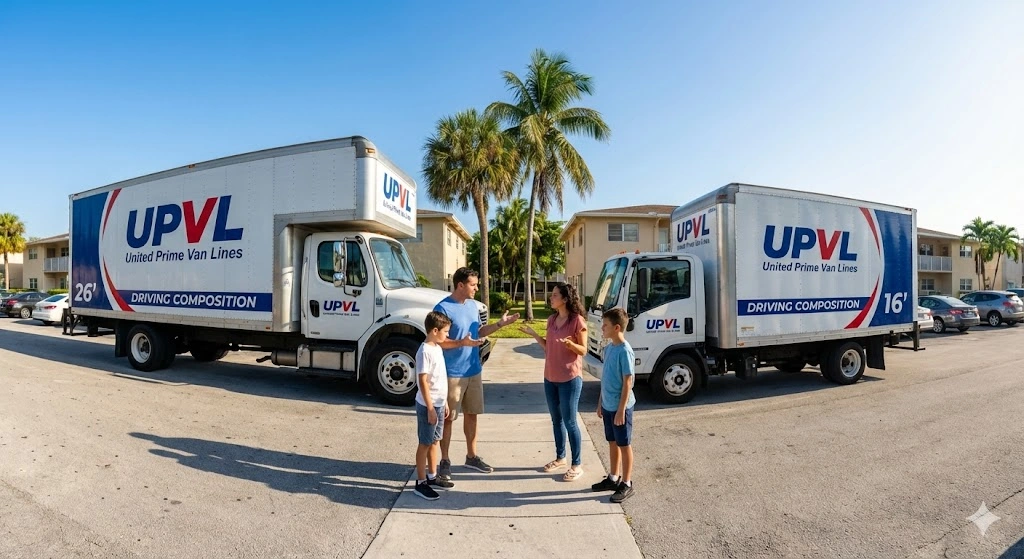
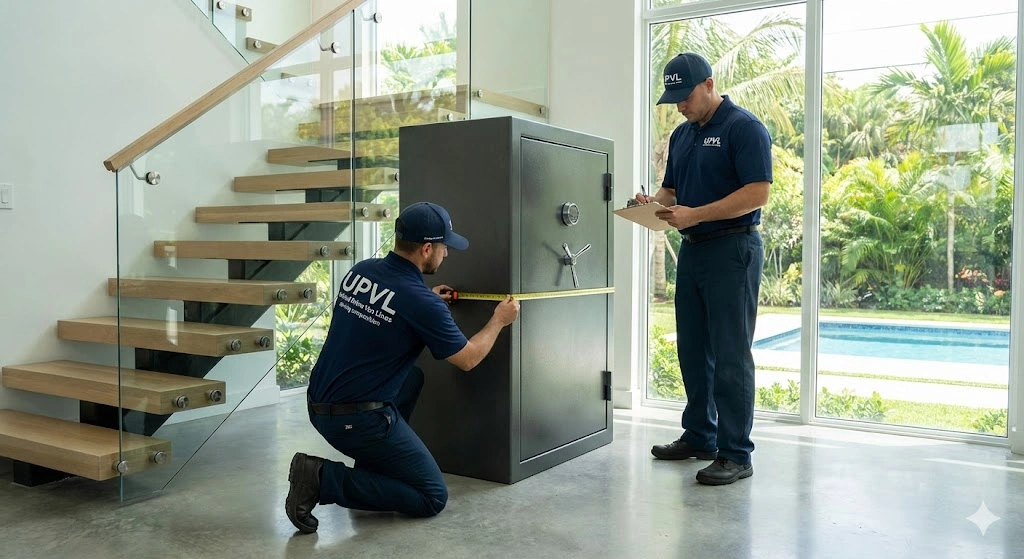
You know that slightly panicky feeling when you realize you have way more stuff than you thought… and now you have to fit it all into a truck you’re not even sure is the right size?
We’ve been there. Every week, someone calls us at United Prime Van Lines with the same question: “What size truck do I need so I don’t make five trips?”
Let’s walk through this like we’re planning your move together. No formulas you’ll never use again—just real-world advice based on what actually happens on moving day.
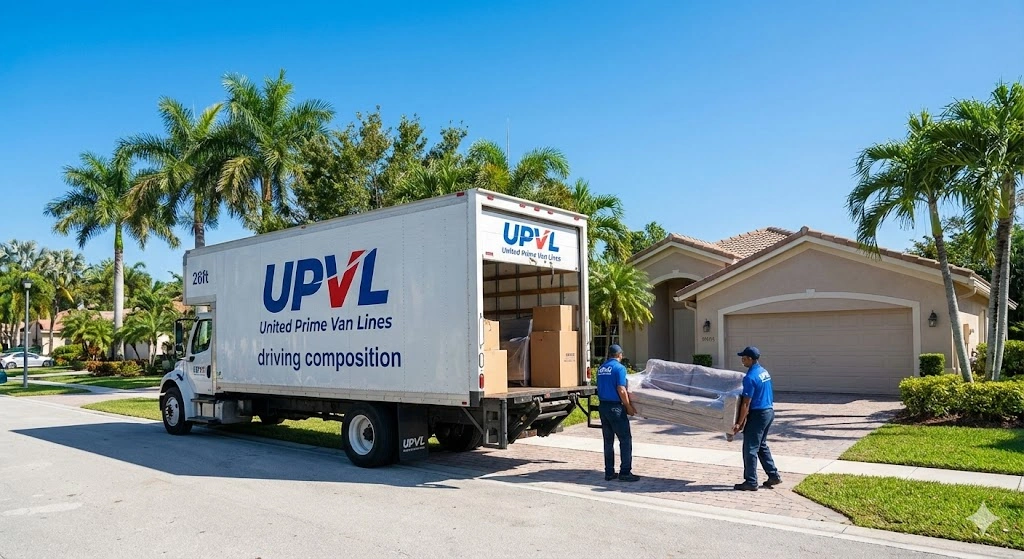
Part 1: The No-BS Size Guide (What Actually Fits)
1. Studio / Small 1-Bedroom (10–12 ft Truck)
- Fits: Bed (Full/Queen), dresser, small sofa, TV stand, 10–20 boxes.
- Best for: Minimalists, dorms, or "IKEA starter packs."
- Warning: Won't fit a large sectional or king mattress easily.
2. Standard 1–2 Bedroom Apartment (15–17 ft Truck)
- Fits: Queen/King bed, sofa + chairs, dining set, 20–40 boxes.
- Best for: Typical Hallandale/LA apartments (800–1,000 sq. ft.).
- Warning: If you have a patio full of furniture or a storage unit, size up.
3. 2–3 Bedroom Home (20–22 ft Truck)
- Fits: 2–3 beds, large sectional, dining table (6 chairs), 30–60 boxes, some garage items.
- Best for: Small families, townhomes, or large apartments.
- Warning: The most common size, but it fills up fast if you haven't decluttered the garage.
4. 3–5 Bedroom Home (24–26 ft Truck)
- Fits: 4+ beds, multiple living areas, formal dining, garage tools, outdoor grill, 80+ boxes.
- Best for: Large single-family homes.
- Warning: If you have a 4,000+ sq. ft. home or a workshop, one truck might not be enough.
Part 2: The "Room Count" Trap (Why Calculators Fail)
Don't just count bedrooms. Ask yourself these three questions:
- Minimalist or Collector? An empty guest room counts for nothing. A wall of vinyl records and guitars counts for a lot.
- Garage Chaos: Online calculators usually forget the garage. Tools, bikes, kayaks, and seasonal bins are volume hogs.
- Box Volume:
- 20 boxes = Studio.
- 60 boxes = Family Home.
- 80+ boxes = Long-time Homeowner.
Part 3: The "Silent Space Killers"
These items ruin your packing plan because they are hard to stack (creating "dead air" in the truck):
- Patio Furniture: Wicker and metal shapes don't fold and can't bear weight.
- Exercise Equipment: Treadmills and Pelotons sit on the floor and usually can't take boxes stacked on top.
- Plants: You can't stack anything on a fern. They take up valuable floor space.
Part 4: How Pros Actually Estimate (Beyond the Square Footage)
When we schedule a move, we build a mental picture of your load based on:
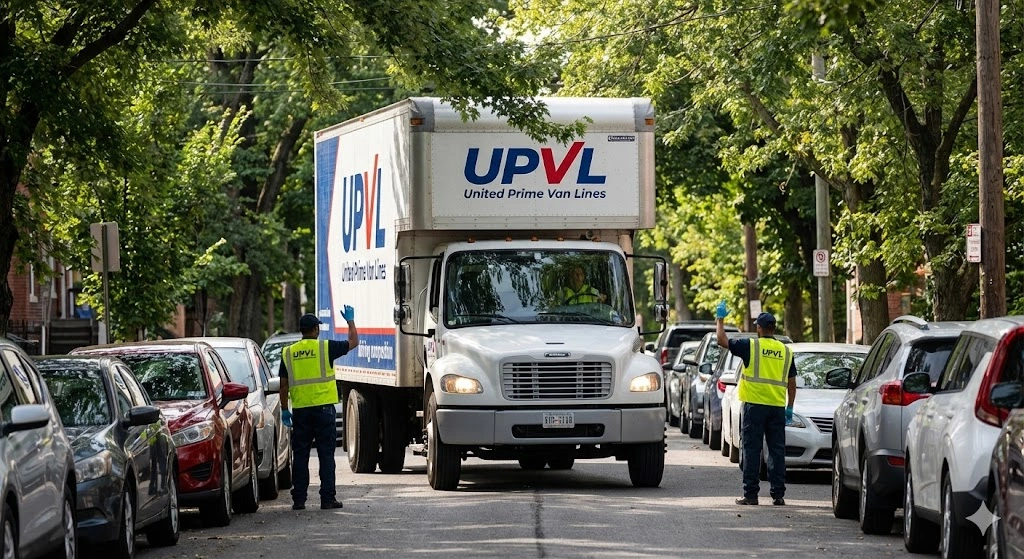
1. Big Furniture Footprint: We calculate "units" of space. A King bed or Sectional Sofa eats up massive volume. 2. Appliances: Fridges and washers are heavy, bulky, and non-stackable. 3. Access Reality: Sometimes the "right" size truck (26 ft) can't fit on your narrow street. We check for low trees and tight gates first.
Part 5: The "Tetris Factor" (DIY vs. Pro)
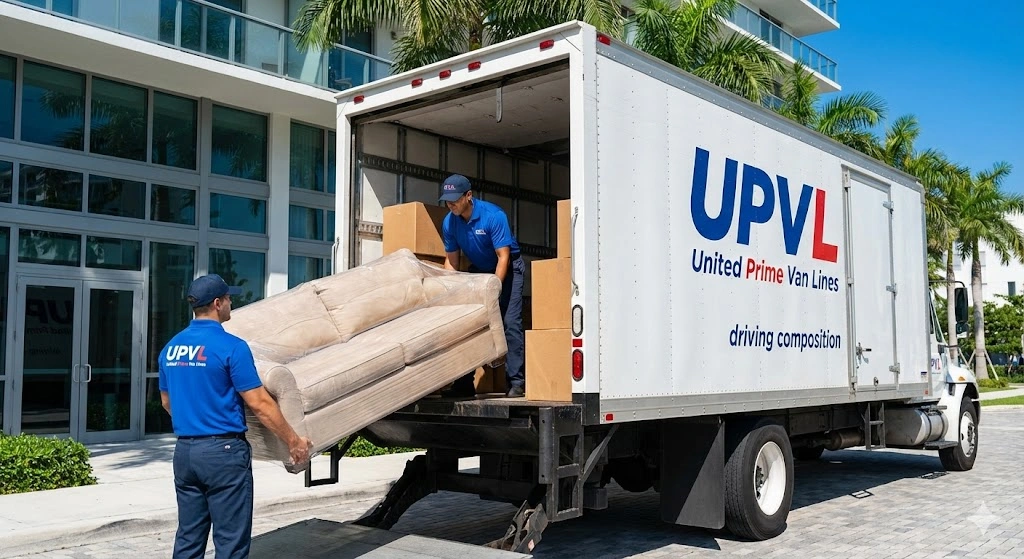
Pro Movers: We disassemble furniture and stack boxes 8 feet high to the ceiling. We utilize 100% of the space. DIY Movers: You likely won't stack as high or tight.
- The Rule: If packing yourself, assume you need 15–20% more space than the math suggests to account for gaps and air.
Part 6: Local vs. Long-Distance Strategy
Local Moves (Short Distance):
- Strategy: You can risk a slightly smaller truck because you can make two trips.
- Pros: Cheaper rental, easier to park.
- Cons: Takes more time, gas, and energy.
Long-Distance Moves (Interstate):
- Strategy: You need One-and-Done.
- Rule: Always overestimate. You cannot drive back from Georgia to Florida for the patio set you left behind.
Summary: The Golden Rule
When in doubt, get the bigger truck. The price difference is usually small ($20–$40), but the cost of leaving furniture behind or making a second trip is huge.
At United Prime Van Lines, we calculate the volume precisely so the right truck shows up every time. No guessing, no left-behind items.