If you’ve ever tried to compare moving companies and felt completely lost in terms like “MC number,” “DOT number,” “intrastate vs interstate,” or “licensed and insured,” you are absolutely not alone.
Most people just want to know one thing:
Can I trust these movers with everything I own?
Licensing and regulations are a big part of that answer. The problem is, moving laws weren’t exactly written for regular people. They were written for lawyers, state officials, and insurance companies.
Let’s break this down in normal language, using real-world examples from places like Hallandale Beach in South Florida and Chatsworth in California—two markets where United Prime Van Lines works with customers all the time.
You might be thinking, “I don’t care about license numbers. I just want my stuff not to disappear.”
That’s exactly why you *should* care about them.
When a mover is properly licensed and follows regulations, it means they’re:
An unlicensed mover, on the other hand, is basically asking you to trust them on vibes alone. If they damage half your furniture, hold your things hostage, or never show up, you’re often left with almost no legal protection.
Licensing doesn’t guarantee perfection. It does give you leverage and a paper trail if something goes wrong.
Here’s the simple breakdown:
So, if you’re:
A serious moving company like United Prime Van Lines has to set up operations to comply with all of this at once—federal and state. That’s one of the reasons a “real” mover will never be the cheapest name you see on Facebook Marketplace.
You’ll notice certain phrases again and again. Here’s how to decode them.
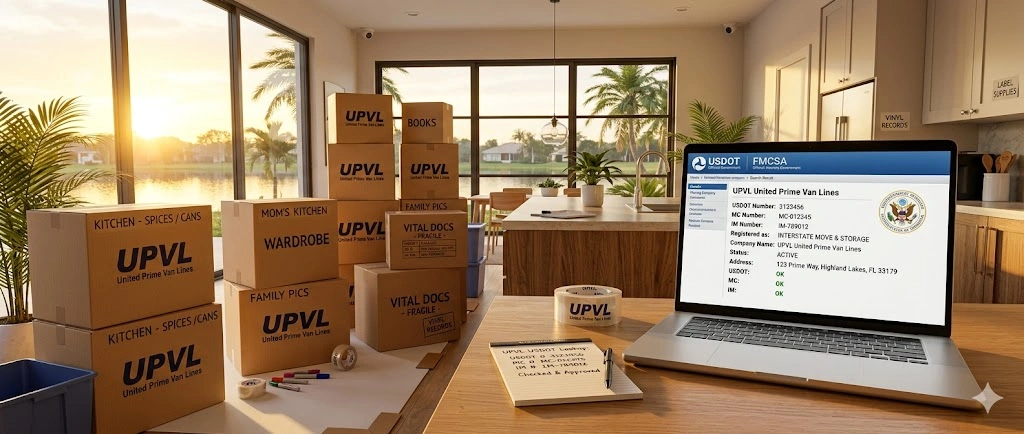
You can search it here:
FMCSA official site: https://safer.fmcsa.dot.gov/CompanySnapshot.aspx
If a company claims to handle **state-to-state moves** and can’t give you a USDOT number? That’s a red flag—not a “maybe,” but a big, serious one.
For interstate moves, you should see both:
United Prime Van Lines, for example, provides both on our documents, because we do interstate residential and commercial moves on a regular basis.
Every mover writes this somewhere. It sounds good. It also tells you almost nothing by itself.
What you want to know is:
1. Licensed where and for what?
2. What insurance do they actually carry?
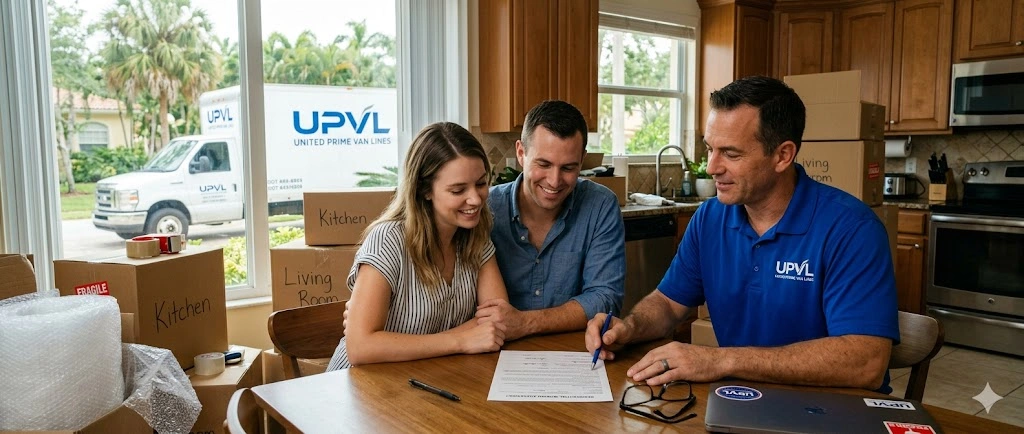
When you talk with a company rep, ask them to spell this out. If they get defensive, change the subject, or say, “Don’t worry about it, you’re covered,” move on.
A legitimate mover will walk you through it calmly, even if it’s a little technical. That’s usually how our conversations go at United Prime Van Lines: lots of questions from the customer, and that’s encouraged.
If your move crosses a state border, federal rules kick in.
Your mover must:
Provide you with:
Offer you at least:
Federal rules also cover:
This is one reason interstate moves feel more “paper-heavy.” That’s not a bad thing—that paper is where your protection lives.
Florida has fairly clear rules for intrastate movers:
They must provide:
They’re not allowed to:
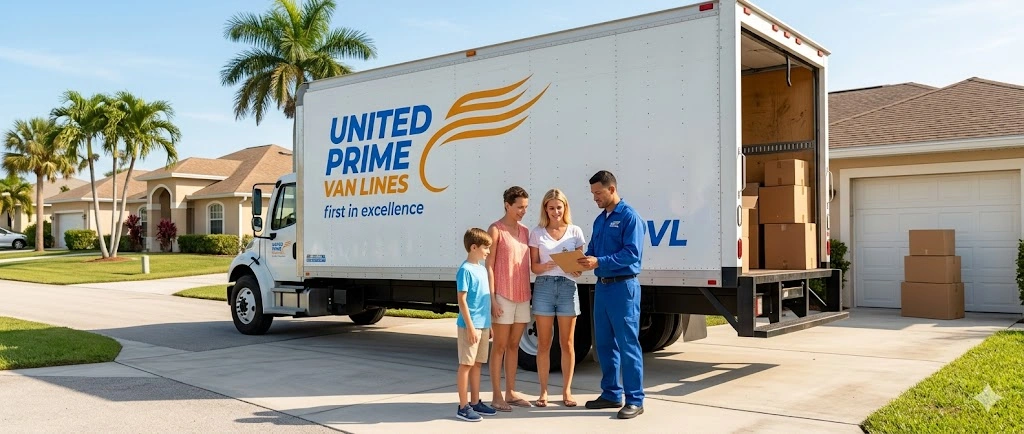
If you book a local move in Hallandale Beach and the mover pressures you to pay way more than the estimate before unloading, Florida law gives you some tools to fight that— if they’re registered and you have documents.
United Prime Van Lines spends a lot of time making sure our Florida paperwork is clear: no mysteries with hourly rates, travel time, extra fees, or what’s included vs. extra.
California takes moving pretty seriously.
Intrastate movers are regulated by the California Public Utilities Commission (CPUC).
For moves within California:
There are rules on:
When you’re moving from Chatsworth to, say, Pasadena or Orange County, a real California mover will show that CAL-T number—usually on their website, trucks, or paperwork. If you don’t see it, ask.
If they hesitate or say, “We’re working under another company’s license,” that’s usually your cue to look elsewhere.
No matter where you’re moving, there are a few basic papers you should expect.
It should clearly state:
What is included:
If the estimate is just a number in a text message or a line in an email like, “Probably around $2,000,” that’s not a proper moving estimate.
This is the legal agreement that locks in:
This may be combined with other documents depending on the company, but it should exist in some clear form you can save.
This is the big one.
The Bill of Lading is:
The final word on:
On moving day, you’ll often sign this when the crew arrives and before they load.
Important: Never sign a blank form. If any section is empty, ask what will be written there, and make sure it’s filled in before you sign.
At United Prime Van Lines, we walk through this with customers—even if they’re in a hurry—because the 5–10 minutes you spend understanding it can save you hours of headache later.
For bigger or long-distance jobs, the crew may create a numbered inventory:
This helps with damage claims later. If a $2,500 TV goes missing, an inventory that shows it was picked up and not delivered is strong evidence in your favor.
One of the most misunderstood parts of moving regulations is **valuation coverage**. A lot of people assume:
> “If they break it, they have to pay me back what it’s worth.”
Not exactly.
On interstate moves, the default legal minimum is:
So if a 200 lb sofa is destroyed, the minimum liability is:
It does not matter if the sofa cost $500 or $5,000. The formula is weight-based, not value-based.
This is why most professional movers recommend upgrading to Full Value Protection or additional third-party insurance for high-value items.
Full Value Protection usually means:
If something is lost or damaged, the mover can:
There is usually:
At United Prime Van Lines, we talk through this during the quote process, not at the truck door. No one likes being asked to make a rushed insurance decision with a crew standing in their living room.
You don’t have to become an insurance expert. You just want to avoid thinking you’re fully covered when legally, you’re not.
Here’s a simple, real-world workflow you can use from your phone or laptop.
For interstate moves:
For in-state moves:
A serious mover will know these off the top of their head or have them clearly listed on their website and email signatures.
For interstate movers:
You’ll see:
For Florida intrastate movers:
For California intrastate movers:
Red flags to watch out for:
If it looks messy already, imagine what your move will look like.
Licensing doesn’t magically remove all bad actors, but most real scam operations avoid licensing altogether or abuse it in obvious ways.
Here are patterns we see far too often.
They quote you something absurdly low, sometimes even without a video or in-person survey.
On moving day:
Properly licensed movers—especially interstate ones—have to follow specific rules on changing estimates and charging more than a certain percentage above the estimate at delivery.
If it’s a registered company with a DOT number and FMCSA authority, you have a better chance of getting help if this happens.
Some companies online aren’t actual movers—they’re **brokers**.
Brokers:
Broking itself isn’t illegal, but a broker must be properly registered as a **household goods broker**, and they must disclose that they’re a broker.
If they hide that and you only find out when a totally different truck shows up on move day, that’s a sign they weren’t playing by the rules.
This is when movers:
Federal and state rules specifically address this for licensed movers. FMCSA and state agencies can intervene in serious cases.
With an unlicensed mover, your options shrink to civil lawsuits and police reports that often go nowhere.
At United Prime Van Lines, we don’t expect customers to become experts in FMCSA regulations or CPUC codes.
What we do aim for is:
- Always providing our license numbers and credentials when asked
- Explaining the difference between **interstate and intrastate moves** in practical terms
- Going over:
- Estimates (and what can change them)
- Valuation coverage options
- What documents you’ll sign and when
If you’re moving from Hallandale Beach to another state, we treat your move under all needed **federal interstate rules**, including your rights and responsibilities booklet, proper Bill of Lading, and clear valuation choices.
If you’re moving within Southern California, say, from Chatsworth to another city, we work within the **California intrastate framework**, using the right forms and disclosures for that market.
Licensing and regulations aren’t a sales pitch for us—they’re just how we operate day to day.
Here’s a short list you can literally copy and paste into an email or keep on your phone.
1. **Are you a carrier, a broker, or both?**
2. **What is your USDOT and MC number?** (for interstate moves)
3. **What license do you operate under for in-state moves in my area?**
- Florida: “Are you registered with FDACS?”
- California: “What’s your CAL-T number?”
4. **Is my estimate binding or non-binding? Under what conditions can the final price change?**
5. **What is your default liability for my items, and what are my options to increase coverage?**
6. **Will I receive a written estimate, order for service, and Bill of Lading before or on moving day?**
7. **Who handles claims if something is damaged or lost, and what is the usual timeline?**
Pay attention not only to **what** they answer but **how** they answer.
If you feel rushed, brushed off, or confused on purpose, go another direction.
Cheap can get very expensive, very fast, when you’re trusting strangers with your home.
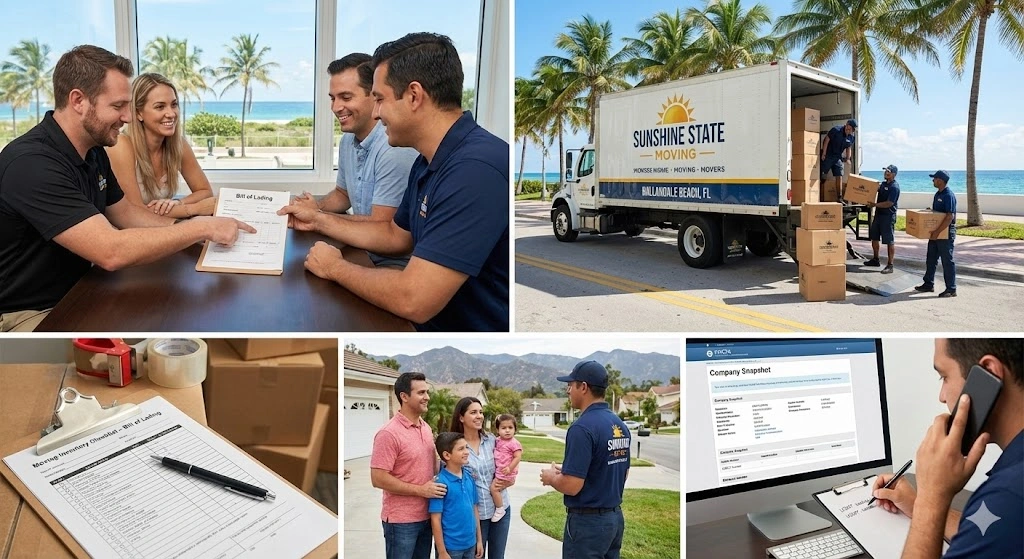
You can plug these into your preferred image tool:
1. *A clean, bright office scene of a moving coordinator in South Florida sitting with a young couple at a desk, reviewing a printed moving estimate and Bill of Lading, with palm trees visible through the window.*
2. *A professional moving truck parked on a residential street in Hallandale Beach, Florida, with movers in uniform loading labeled boxes, and the ocean or tropical foliage subtly in the background.*
3. *Close-up shot of a clipboard showing a moving inventory checklist and Bill of Lading, with a pen, packing tape, and cardboard boxes stacked behind it.*
4. *A family standing in front of a house in Chatsworth, California, talking with a mover in branded uniform, mountains and typical San Fernando Valley homes in the background.*
5. *A split-screen style image showing a computer screen with the FMCSA Company Snapshot page on one side, and a person on a phone verifying a mover’s USDOT number on the other side.*
You don’t have to memorize every detail of moving law. What you *do* need is a basic feel for what’s normal and what’s not.
If you remember nothing else from this article, hang onto this:
Whether you’re moving a condo in Hallandale Beach, a house in Chatsworth, or relocating across the country, taking 15–20 minutes to verify licensing and ask direct questions can easily be the difference between a smooth move and a horror story.
And if you want someone to actually walk you through this step-by-step—what applies to your specific move, what protections make sense, and how to keep surprises off your invoice—that’s exactly the kind of conversation we have with customers every day at United Prime Van Lines.