Running a small business is already a full‑time job. Add “plan a move” on top of that, and suddenly you’re juggling landlords, internet providers, furniture, employees, and a ticking clock you can practically hear.
We talk to small business owners all the time—law firms, salons, small medical offices, marketing agencies, accounting firms, e‑commerce shops—and the same question always comes up:
“Do we really need a professional moving company, or can we just DIY this and save some money?”
Let’s walk through that honestly.
We’re United Prime Van Lines, and this is what we do every day. We’re not here to scare you into hiring us. We’re here to help you see where a specialist mover truly makes sense, and where you might be fine with a smaller solution.
On paper, your office or shop might not look like much:
A few desks, some computers, a break room, maybe a couple of file cabinets or display shelves. Easy, right?
In reality, moving a small business is about way more than the physical stuff:
What makes business moves tough isn’t just the weight of the desks—it’s the cost of being offline. Every hour your systems, phones, or doors are down, you’re losing money and trust.
That’s where we start thinking: “Is this something we can manage ourselves, or is this when a specialist mover is worth every penny?”
Not every moving company is ready for business moves, and not every “office mover” really acts like a partner. When we say “specialist mover,” here’s what we mean—and what you should look for, whether you call us or someone else:
Residential movers think in terms of “move day.”
Business movers think in terms of “downtime.”
A specialist mover should be asking you:
Our planning for small business moves often starts with just these three questions. If a mover isn’t talking about your operating hours and timelines, they’re not really thinking like a business partner.
For most small businesses, the most valuable “furniture” is the stuff that doesn’t look valuable:
A specialist mover should:
We’re not your IT provider, but we work *with* them. If no one is thinking about your tech, you don’t have a true office mover—you have a heavy-lifting service.
A regular mover will say: “We’ll show up at 9, load, and unload.”
A specialist mover will ask:
For example, with United Prime Van Lines, we often:
This kind of sequencing reduces chaos, which usually reduces your stress and your downtime.
Let’s be honest: not every small business move needs a full-scale specialist mover. There are cases where a light solution—pickup trucks, a van, staff help—can work just fine.
Here’s when DIY or a basic moving crew *might* be enough:
You might be okay with a minimal setup if most of this is true:
If you can break everything down into standard boxes and a couple of furniture pieces, and your biggest concern is “don’t scratch the desk,” you might not need specialists.
Think about what happens if you’re down for a day or two:
Some creative agencies, solo consultants, or freelancers can get away with a bit of downtime. If you can work from home or a café during the move, your need for a specialist goes down.
If you’ve got:
…then you may be able to run the move yourself in phases.
In those cases, what we sometimes recommend is:
We’re in this business, and we’ll still tell you: if you can safely, reasonably move yourself without major risk or downtime, that’s okay.

Now let’s flip it around. These are the moments where we’d seriously urge you to consider a professional small business mover—us or someone comparable.
Some businesses can’t afford a pause:
If bumping or canceling appointments could hurt your reputation or revenue, the move has to be tight:
This is where we lean hard into planning at United Prime Van Lines:
We design moves around your business clock, not ours.
If any of this sounds like you:
Then you need people who understand chain of custody and privacy.
In these cases, we:
If someone’s entire case or medical history is in a box, that’s not “just another box.”
Some examples where we always recommend a specialist mover:
These aren’t items you “figure out on the day.” They often require:
When we take on this type of move, we plan around those key pieces first—everything else works around them.
A lot of business spaces—especially in places like Hallandale Beach, Miami, Fort Lauderdale, or downtown LA—come with building rules, like:
If your property manager is sending long emails with requirements, that’s a major sign you need a mover who’s used to dealing with commercial buildings. We deal with COIs and building managers constantly; it’s part of our normal prep.

Let’s put this into something you can quickly think through.
Ask yourself these five questions:
1. What’s one day of downtime worth to us?
2. What’s the most expensive or irreplaceable thing we own?
If damaging that would be a disaster, you want professionals on it.
3. Who is actually going to run this move?
4. How complex is our space?
The more moving parts, the more a specialist helps.
5. What’s my stress level just thinking about it?
When we talk to small business owners at United Prime Van Lines, we often walk through exactly these questions. Sometimes the call ends with: “You know what? I think we can handle this ourselves.” And that’s okay. Other times, the answer is very clear: “Nope, we need help.”
Every mover says they’re “full service,” so let’s be specific about what we can actually handle for you.
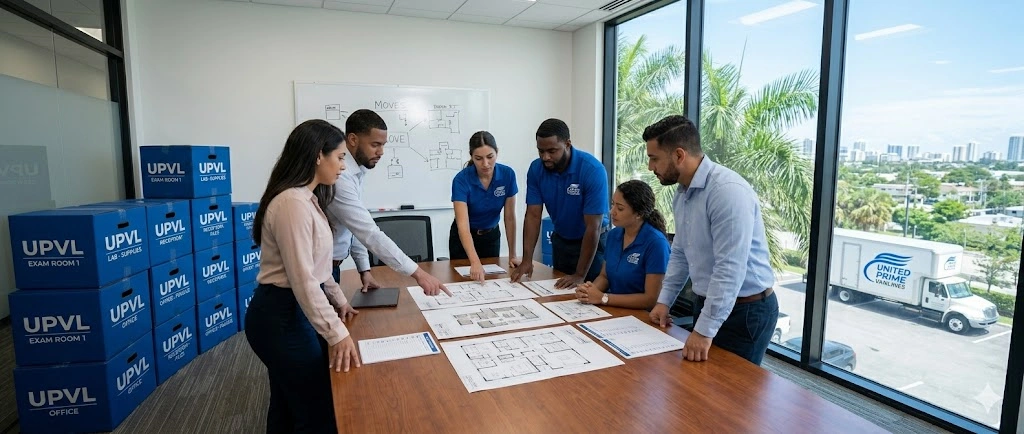
We like to walk your space (or do a video call) and:
In South Florida, that might mean a walkthrough at your Hallandale Beach office on W Hallandale Beach Blvd, or a space in Aventura, Hollywood, or Fort Lauderdale. In California, maybe your Chatsworth office in a business park off Devonshire or Nordhoff. Different buildings, same planning mindset.
Then we build a plan that sounds more like a schedule than a quote:
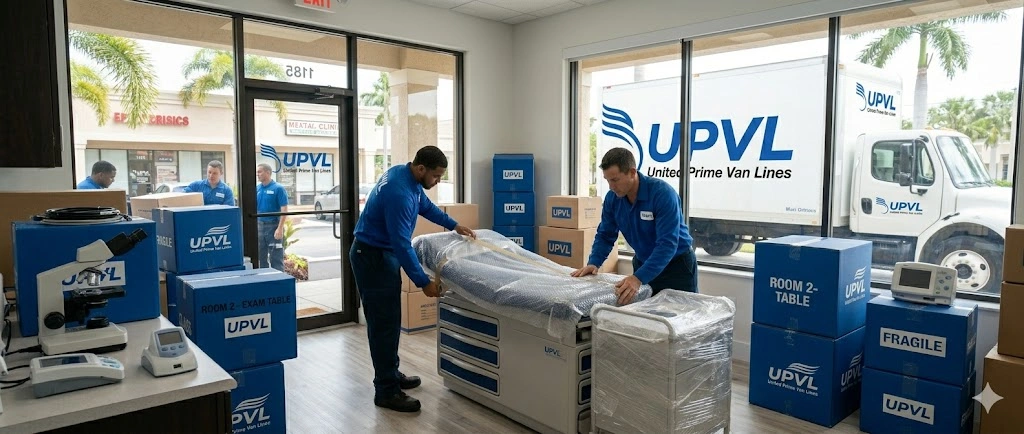
We can pack everything for you, or split it up:
We label everything in a way that makes sense on the other side:
This avoids the classic move nightmare: 50 unlabeled boxes and a new space full of question marks.
Desks, conference tables, bookcases, shelving systems—if it came in, it can come out and go back together.
We bring the tools and the experience to:
If you’re upgrading some furniture, we can often help you move old items to storage, donate them, or dispose of them properly.
With your permission, we can:
We want move day to be about moving, not arguing with a security guard about elevator access.
For many small businesses, the only realistic time to move is when customers aren’t around. In South Florida and Southern California where traffic and business hours can be a headache, we regularly:
You lock your old door Friday. We’re with you Saturday or Sunday. You unlock a new door on Monday, and everything’s where it belongs.

We’ve been called in more than once to “rescue” a move that started as a DIY project. Here are some things we see over and over—things you can learn from even if you don’t hire us.
Packing an office always takes longer than people think.
If you’re not using specialists, build in more time than you think you’ll need—and be very clear who owns what part of packing.
If “everyone” is in charge of the move, no one really is.
On a decent-sized small business move, we assign a lead on our side. You should have a lead on your side too—someone with authority to make decisions, answer questions, and change the plan if needed.
Without a point person, small problems turn into big ones fast.
When you move yourself or use casual labor, there’s usually no:
With a professional, licensed mover like United Prime Van Lines, you’re working with:
You don’t want a friend of an employee slipping on a stair with no coverage in place.
Everyone focuses on the big day: trucks, loading, unloading. But the real drag is the last 10%:
We build that last 10% into our planning so you’re not stuck in limbo for weeks. Without that, you risk living in a half-moved, half-operational space that wears everyone down.
We don’t walk in and tell you how to run your business. Our goal is simple: protect your time, your people, and your stuff.
Here’s how we usually fit into the picture:
If you’re in Hallandale Beach or anywhere else in South Florida, we know the local buildings, the traffic patterns, the parking headaches, and the weather quirks (yes, we plan around those summer storms). If you’re in Chatsworth or other Southern California areas, we’re used to business parks, tight loading docks, and building rules.
You stay focused on clients and operations. We handle the heavy lifting, the planning, and the coordination.
To wrap it up into something practical, look at this list. If you’re saying “yes” to most of these, a specialist mover—like us—is probably the smarter move:
If instead you’re thinking:
- “We’re super small, flexible, and light,”
- “Our clients can tolerate a brief downtime,” and
- “We don’t have anything sensitive or fragile,”
…then you might be able to keep it simple, and we’ll be the first to tell you that on a call.
When you’re ready to actually talk through **your** situation—not some generic checklist—we’re here. At United Prime Van Lines, we treat your move like what it really is: a critical moment for your business, not just another truckload of boxes.